

Summary: Below-knee prosthetics, also known as transtibial prostheses, are among the most commonly prescribed prosthetic solutions for individuals who have experienced lower limb loss below the knee. Thanks to advancements in prosthetic technology, today’s below-knee prosthetics offer improved comfort, mobility, and functionality. This guide explores the different types of below-knee prosthetic options, their components, benefits, and factors to consider when choosing the right solution for your lifestyle and mobility goals.
Losing a limb can be a life-changing experience, but modern prosthetic technology has made it possible for individuals to regain independence and enjoy an active lifestyle. For people who have undergone an amputation below the knee, a below-knee prosthetic—also known as a transtibial prosthesis—can provide exceptional mobility and function.
Because the knee joint remains intact, below-knee amputees often experience greater stability, more natural movement, and a faster rehabilitation process compared to higher-level amputations. However, selecting the right prosthetic solution requires a clear understanding of the available options and how they align with your individual needs.
In this guide, we’ll explore the different types of below-knee prosthetics, their key components, and how to choose the most suitable option for your lifestyle.
What Is a Below-Knee Prosthesis?
A below-knee prosthesis is an artificial limb designed for individuals who have undergone an amputation below the knee joint. Since the natural knee remains functional, users can maintain better control and mobility during walking and other activities.
The primary goals of a below-knee prosthetic are to:
- Restore mobility
- Improve balance and stability
- Increase independence
- Enhance quality of life
- Support participation in daily activities
Modern prosthetic designs are highly customizable and can be tailored to match the user’s activity level, physical condition, and personal goals.
Key Components of a Below-Knee Prosthetic
Understanding the basic components of a prosthetic limb can help users make informed decisions.
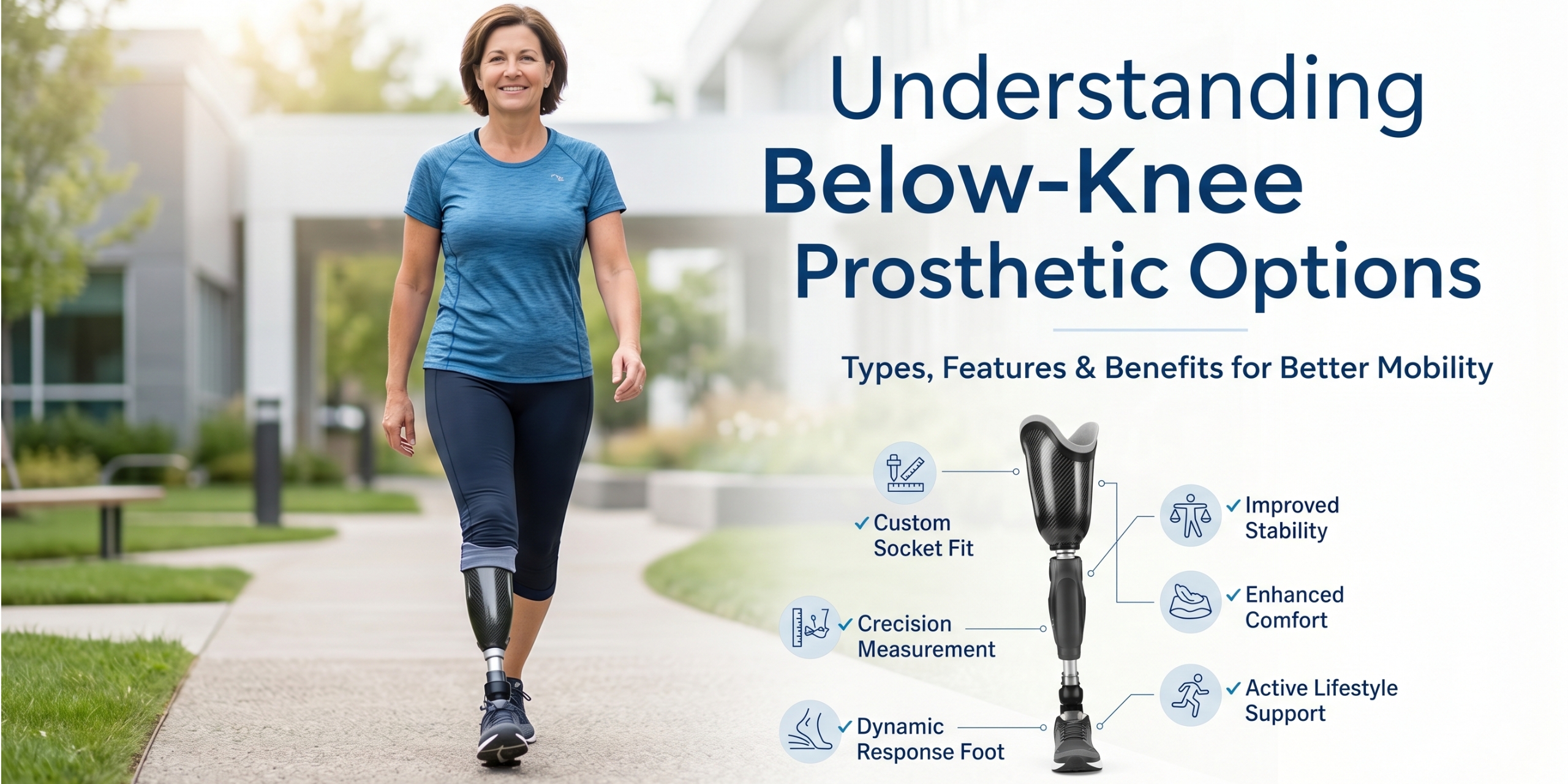
Socket
The socket is the part of the prosthetic that connects to the residual limb.
A properly fitted socket is essential for:
- Comfort
- Stability
- Weight distribution
- Long-term prosthetic success
Many modern sockets are custom-designed using advanced measurement and digital scanning technologies.
Prosthetic Liner
The liner acts as a cushion between the residual limb and the socket.
Benefits include:
- Reduced friction
- Improved comfort
- Better suspension
- Protection against skin irritation
Suspension System
The suspension system keeps the prosthetic securely attached to the residual limb.
Common suspension options include:
- Pin-lock systems
- Suction suspension
- Vacuum suspension
- Sleeve suspension
The ideal system depends on the user’s preferences and activity level.
Prosthetic Pylon
The pylon serves as the structural connection between the socket and foot.
Modern pylons are often made from lightweight materials such as aluminum, titanium, or carbon fiber.
Prosthetic Foot
The prosthetic foot plays a critical role in walking performance, balance, and shock absorption.
Different foot designs are available to meet various mobility requirements.
Types of Below-Knee Prosthetic Feet
One of the most important decisions involves selecting the appropriate prosthetic foot.
Solid Ankle Cushioned Heel (SACH) Foot
The SACH foot is one of the most basic prosthetic foot designs.
Benefits
- Durable construction
- Cost-effective
- Low maintenance
- Suitable for low-activity users
Limitations
- Limited flexibility
- Less natural movement
Single-Axis Foot
This foot design allows movement primarily in one direction.
Benefits
- Improved stability
- Better shock absorption
- Suitable for users requiring additional balance support
Multi-Axial Foot
Multi-axial feet allow movement in multiple directions.
Benefits
- Better adaptation to uneven terrain
- Improved balance
- Enhanced walking comfort
These feet are often recommended for active users who frequently walk on varying surfaces.
Dynamic Response Foot
Dynamic response feet are designed to store and release energy during walking.
Benefits
- More natural gait
- Increased walking efficiency
- Reduced fatigue
- Enhanced mobility
These feet are popular among active individuals.
Energy-Storing Carbon Fiber Foot
These advanced prosthetic feet use carbon fiber technology to improve movement and performance.
Benefits
- Lightweight design
- Excellent energy return
- Greater comfort
- Improved walking speed
They are commonly used by highly active individuals and athletes.
Choosing the Right Below-Knee Prosthetic Option
Selecting the right prosthetic solution requires careful consideration of several factors.
Activity Level
Activity level is one of the most important considerations.
Low Activity Users
Individuals who primarily move indoors or walk short distances may benefit from basic prosthetic systems.
Moderate Activity Users
People who walk regularly and participate in daily community activities often benefit from dynamic response feet.
High Activity Users
Athletes and highly active individuals typically require advanced prosthetic components designed for enhanced performance.
Occupation
Work-related demands can influence prosthetic selection.
For example:
- Office workers may prioritize comfort.
- Construction workers may require durability.
- Healthcare professionals may need prolonged standing support.
Lifestyle Goals
Your prosthetic should align with your personal interests and recreational activities.
Common goals may include:
- Walking independently
- Traveling
- Exercising
- Participating in sports
- Returning to work
Budget Considerations
Prosthetic technology varies significantly in cost.
Factors affecting pricing include:
- Materials used
- Technology level
- Customization requirements
- Additional features
Working with a qualified prosthetist can help identify the best option within your budget.
Benefits of Below-Knee Prosthetics
Modern below-knee prosthetics provide numerous advantages.
Improved Mobility
The ability to walk confidently and independently is often the most significant benefit.
Better Energy Efficiency
Because the knee joint remains intact, below-knee amputees generally expend less energy while walking compared to above-knee amputees.
Enhanced Stability
Preserving the natural knee joint provides greater balance and control.
Faster Rehabilitation
Many individuals experience quicker rehabilitation and adaptation compared to higher-level amputations.
Greater Independence
Prosthetic users often regain the ability to perform daily activities without relying heavily on assistance.
Rehabilitation After Receiving a Below-Knee Prosthetic
Rehabilitation is essential for maximizing the benefits of a prosthetic limb.
Physical Therapy
Physical therapy helps improve:
- Strength
- Flexibility
- Balance
- Coordination
Gait Training
Gait training teaches users how to walk efficiently and safely using their prosthetic.
Functional Training
Users learn practical skills such as:
- Climbing stairs
- Navigating uneven terrain
- Carrying objects
- Performing daily tasks
Consistent rehabilitation can significantly improve long-term outcomes.
Common Challenges and Solutions
Socket Discomfort
Changes in residual limb shape can affect fit.
Solution
Regular adjustments by a prosthetist can improve comfort and function.
Skin Irritation
Prolonged wear may occasionally cause skin issues.
Solution
Proper hygiene, socket adjustments, and liner management can help prevent problems.
Balance Concerns
New users often experience temporary balance difficulties.
Solution
Balance exercises and physical therapy help build confidence and stability.
Advances in Below-Knee Prosthetic Technology
Technology continues to improve the functionality of below-knee prosthetics.
Microprocessor-Assisted Components
Smart systems help optimize movement and stability.
Lightweight Materials
Modern materials improve comfort while reducing fatigue.
3D-Printed Prosthetics
3D printing enables:
- Faster production
- Enhanced customization
- Reduced manufacturing costs
Smart Prosthetic Systems
Some advanced devices collect data that helps clinicians optimize fit and performance.
Finding the Right Prosthetic Partner
Choosing the right prosthetic provider is just as important as selecting the right device.
Look for a clinic that offers:
- Experienced prosthetists
- Customized solutions
- Advanced technology
- Comprehensive rehabilitation support
- Ongoing follow-up care
A trusted prosthetic partner can help ensure long-term comfort and mobility.
Achieving Greater Mobility with the Right Below-Knee Prosthetic
Below-knee prosthetics have transformed the lives of countless individuals by restoring mobility, independence, and confidence. With a wide range of prosthetic feet, suspension systems, and advanced technologies available, today’s users can find solutions tailored to their unique needs and lifestyle goals.
Understanding your options is the first step toward making an informed decision and achieving the best possible outcome. With the right prosthetic device, proper rehabilitation, and professional support, individuals can return to daily activities, pursue their passions, and enjoy a fulfilling life.
Choose Expert Prosthetic Care with PROACTIVE Technical Orthopaedics!
At PROACTIVE Technical Orthopaedics, we are committed to helping individuals achieve greater mobility through personalized prosthetic solutions. As the best prosthetics manufacturer in India, we provide advanced below-knee prosthetic devices, expert fittings, and comprehensive rehabilitation support tailored to each patient’s needs.
Our experienced team combines cutting-edge technology with compassionate care to ensure the highest level of comfort, functionality, and independence. Contact PROACTIVE Technical Orthopaedics today and discover how the right below-knee prosthetic solution can help you move forward with confidence.