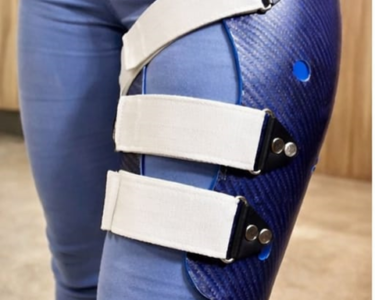



The prosthetic socket plays a vital role in the success of any prosthetic limb, as it forms the direct connection between the amputee’s residual limb and the prosthetic system. A well-designed socket is essential for comfort, stability, efficient load transfer, and effective control of the prosthesis. Without a proper fit, even the most advanced prosthetic components cannot deliver optimal performance.
A poorly fitted socket is one of the most common reasons why amputees discontinue prosthesis use. Problems such as discomfort, skin breakdown, instability, and lack of control often arise due to improper socket design or biomechanical issues. Therefore, achieving a precise and comfortable socket fit is a critical part of the rehabilitation process.
The socket fabrication process begins with accurate measurement and casting of the residual limb. A negative cast is taken and then filled with plaster to create a positive mould. This mould is carefully modified in a process known as rectification, where pressure-tolerant and pressure-sensitive areas are addressed to ensure even load distribution and comfort.
In many cases, a diagnostic or test socket is fabricated before producing the final socket. These test sockets are usually made from transparent plastic, allowing the prosthetist to visually assess fit, pressure areas, and limb alignment. Multiple fitting sessions may be required to fine-tune the socket design and ensure optimal comfort and function.
Once the fit is finalized, the definitive socket is fabricated using durable materials such as carbon fiber, fiberglass, or reinforced nylon with resin lamination. The choice of material depends on the user’s activity level, weight, and functional needs.
Ultimately, the success of a prosthesis depends largely on the skill and experience of the prosthetist. Precise measurements, careful casting, and expert rectification are essential to achieve a socket that provides comfort, stability, and confidence. Regardless of the materials used, a well-fitted socket is the foundation for effective mobility and successful rehabilitation.
Pressure-Tolerant and Pressure-Sensitive Areas in Prosthetic Sockets
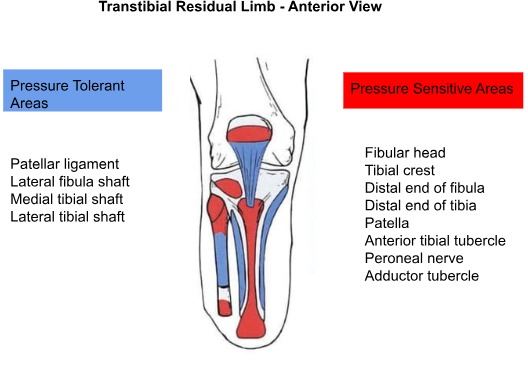
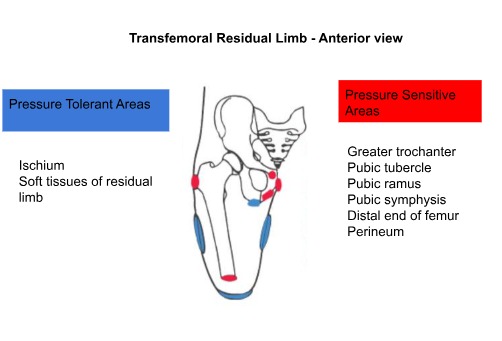
A prosthetic socket is the part of the artificial limb that comes in direct contact with the residual limb. Because it carries body weight and controls movement, the socket must be comfortable and properly fitted.
When a person uses a prosthesis, pressure is applied to different areas of the residual limb. If this pressure is spread evenly over a larger area, it feels more comfortable and reduces pain or skin problems.
Pressure-Tolerant Areas
Pressure-tolerant areas are parts of the residual limb that can safely handle pressure. Mild redness may appear in these areas after removing the prosthesis, but it should disappear quickly and should not cause skin damage. These areas are used to support body weight and improve balance and control.
Pressure-Sensitive Areas
Pressure-sensitive areas cannot tolerate pressure. Any redness, pain, or irritation in these areas is not normal and may lead to skin wounds. These areas must be relieved during socket fitting. If discomfort is noticed, the prosthetist should be consulted immediately.
Importance of Stump Length and Quality
Very short below-knee (transtibial) stumps may have difficulty supporting body weight and controlling the prosthesis. However, the overall quality of the residual limb—such as skin health and muscle condition—is often more important than length alone.
Why a Proper Socket Fit Matters
- A well-fitted prosthetic socket:
- Improves comfort
- Prevents skin problems
- Enhances walking and balance
- Increases confidence and prosthesis use
Prosthetic Socket Designs: Transtibial and Transfemoral Options Explained
Choosing the correct prosthetic socket design is one of the most important factors in achieving comfort, stability, and long-term success in amputee rehabilitation. Both transtibial (below-knee) and transfemoral (above-knee) amputees require socket designs that match their residual limb shape, activity level, and medical condition.
Below is an overview of commonly used transtibial and transfemoral prosthetic sockets, including their indications, advantages, and limitations.
Transtibial (TT) Prosthetic Sockets
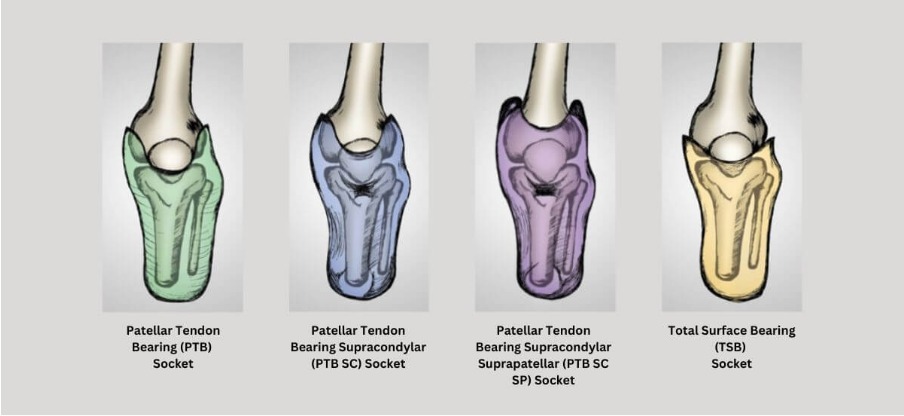
Patellar Tendon Bearing (PTB) Socket
The PTB socket is a traditional transtibial socket design where body weight is primarily borne through the patellar tendon, just below the kneecap. Suspension is typically achieved using a belt around the distal thigh.
While this socket design has been widely used, prolonged belt suspension may restrict blood and lymphatic circulation and, over time, may contribute to muscle atrophy.
Patellar Tendon Bearing Supracondylar (PTB-SC) Socket
In the PTB-SC socket, weight bearing still occurs at the patellar tendon, but suspension is achieved by enclosing the medial and lateral femoral condyles. This eliminates the need for belt suspension and reduces circulation-related problems.
This design is currently one of the most commonly used transtibial socket designs worldwide, especially for individuals with medium to long residual limbs.
Patellar Tendon Bearing Supracondylar Suprapatellar (PTB-SC-SP) Socket
The PTB-SC-SP socket provides additional suspension by extending over the suprapatellar area. Along with condylar support, this design improves knee stability.
Total Surface Bearing (TSB) Sockets
The Silicone Suction Socket (SSS) is a total surface bearing socket, meaning body weight is distributed evenly across the entire residual limb. Suspension is achieved using a silicone liner with either a distal locking pin or a suction mechanism. This design provides full contact throughout the gait cycle, reducing pressure peaks and improving comfort.
Advantages of TSB Sockets
- Ideal for active amputees due to lower trim lines
- Reduced socket pistoning
- Improved proprioception and balance
- Better suspension compared to PTB designs
- More uniform pressure distribution, increasing comfort
Disadvantages and Contraindications of TSB Sockets
- Hydraulic Primary amputees due to limb volume changes
- Patients undergoing dialysis or with fluctuating limb volume
- Very short residual limbs (less than 10 cm)
- Individuals with bony prominences or distal end sensitivity
- Patients with excessive soft tissue
- Amputees with visual, sensory, or neurological impairment
Transfemoral (TF) Prosthetic Sockets
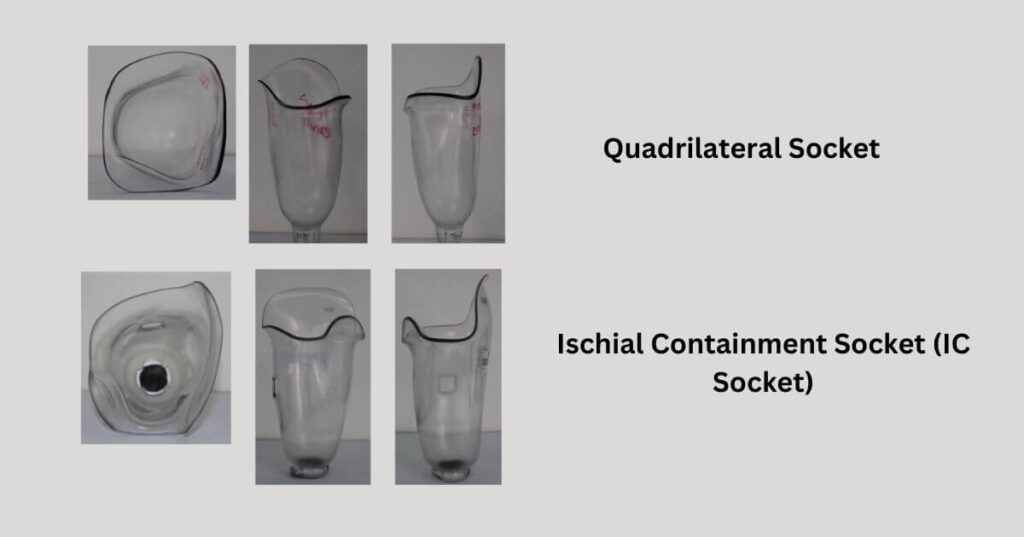
Quadrilateral Socket
The quadrilateral transfemoral socket is one of the most widely used designs for above-knee amputees. Weight bearing occurs primarily at the ischial tuberosity, supported by the posterior shelf of the socket.
Suspension is achieved through suction, created by an intimate socket fit. In some cases, additional suspension belts such as Silesian or neoprene belts may be used.
This socket design is suitable for a wide range of residual limb shapes and remains a common choice in modern prosthetic practice.
Ischial Containment socket
An above knee prosthetic socket, also known as a transfemoral prosthetic socket, is the most critical component of an above-knee prosthesis as it forms the primary interface between the residual limb and the artificial limb. The socket is responsible for weight bearing, stability, suspension, and control of the prosthesis during standing and walking. Proper socket design ensures effective load transfer through anatomical structures such as the ischial tuberosity and surrounding soft tissues, while protecting pressure-sensitive areas. A well-fitted transfemoral socket plays a vital role in improving comfort, balance, gait efficiency, and overall prosthetic function during amputee rehabilitation.
The success of an above knee prosthesis largely depends on accurate casting, precise rectification, and appropriate socket selection based on the patient’s residual limb shape, muscle strength, and activity level. Modern transfemoral socket designs, including quadrilateral and ischial containment sockets, aim to enhance mediolateral stability, reduce pistoning, and improve suspension through suction or liner-based systems. Poor socket fit can lead to pain, skin breakdown, reduced control, and eventual prosthesis rejection. Therefore, expert prosthetic socket fabrication and regular follow-up adjustments are essential to achieve long-term comfort, mobility, and user satisfaction.
Importance of Proper Socket Selection
Regardless of the socket type, a successful prosthesis depends on:
- Accurate casting and rectification
- Proper pressure distribution
- Appropriate suspension method
- Matching socket design to patient lifestyle and anatomy
- A well-designed prosthetic socket improves comfort, mobility, balance, and long-term prosthesis acceptance.
Prosthetic Suspension Systems: Types, Advantages, and Limitations
A prosthetic suspension system is responsible for securely holding the prosthetic socket on the residual limb during standing, walking, and swing phase of gait. An effective suspension system improves comfort, stability, confidence, and overall prosthetic control. Selecting the right suspension method depends on residual limb shape, activity level, hand strength, and volume changes. Below are the most commonly used prosthetic suspension systems in modern transtibial and transfemoral prosthetics.
1. Cuffs, Straps, and Belts (Auxiliary Suspension)
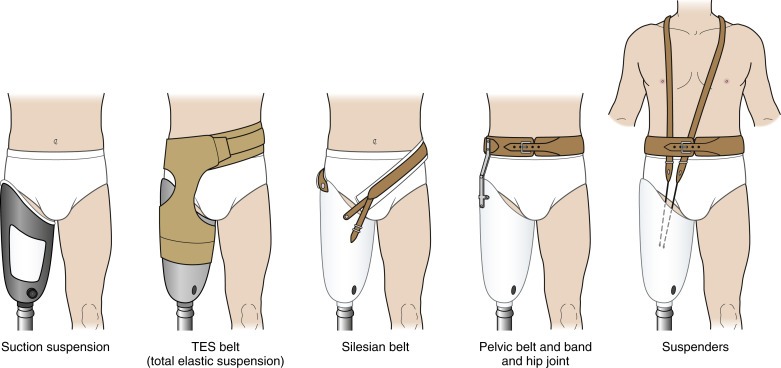
Cuffs, straps, and belts are among the earliest forms of prosthetic suspension and are still used today due to their simplicity, durability, and low cost. These systems prevent the prosthesis from slipping off during the swing phase.
Indications
- Short residual limbs
- Patients with fluctuating limb volume
- Weak hip abductor muscles
Disadvantages
- Yes, Can feel warm and uncomfortable
- Pressure around the pelvis
- Moves during sitting
- Provides limited suspension and may cause skin irritation or bruising
2. Lanyard Suspension System

Pneumatic The lanyard suspension system uses a cord or strap attached to the distal end of a prosthetic liner. As the user inserts the residual limb into the socket, the lanyard passes through a hole in the socket and is tightened externally to secure suspension.
Advantages
- Easy donning while seated
- Ideal for users with poor balance
- Secure suspension with reduced socket rotation
Disadvantages
- Requires some hand strength and coordination
- Always requires a prosthetic liner
3. Self-Suspending Prosthetic Socket
A self-suspending socket achieves suspension through the shape of the socket brim itself. The socket is designed to grip over a joint, such as the knee, to prevent the prosthesis from slipping off.
4. External Suspension Sleeve
An external suspension sleeve fits tightly over the prosthetic socket and extends onto the thigh, creating an airtight seal that enhances suspension. Sleeves are commonly made from neoprene, silicone, or copolymer gel.
Advantages
- Reduces pistoning inside the socket
- Allows knee flexion with ribbed or wave-design sleeves
- Improves cosmetic appearance by covering the socket edge
- Reliable and relatively affordable
Disadvantage
- Improper application may cause skin irritation
- Requires hand strength and dexterity
- Wear and tear reduces effectiveness
5. Pin and Lock Suspension System
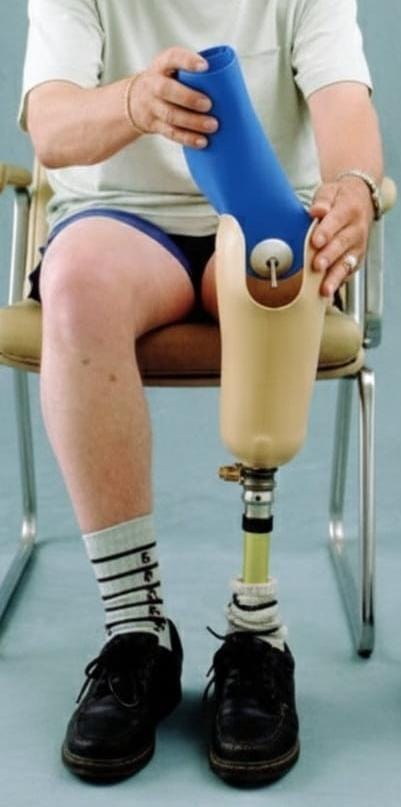
The pin and lock suspension system uses a silicone or gel liner with a distal pin that locks into a mechanical housing at the bottom of the socket. This system is widely used in both transtibial and transfemoral prosthetics.
Advantages
- Secure mechanical locking with audible feedback
- Easy donning and doffing in sitting position
- Accommodates moderate limb volume changes
Disadvantages
- Distal traction may cause skin issues if not managed properly
- Liner wear and tear over time
- Misalignment of the pin can prevent locking, which may be challenging for users with poor eyesight or limited flexibility
6. Suction Suspension Without a Liner
This traditional suction suspension system relies on direct contact between the residual limb skin and the socket. Air is expelled through a valve to create negative pressure.
Advantages
- Excellent suspension with accurate socket fit
- Less expensive compared to liner-based systems
Disadvantages
- Difficult donning technique
- Requires good balance, hand strength, and coordination
- Poor suspension with limb volume changes
- Valve failure can result in loss of suspension
7. Suction Suspension With a Liner
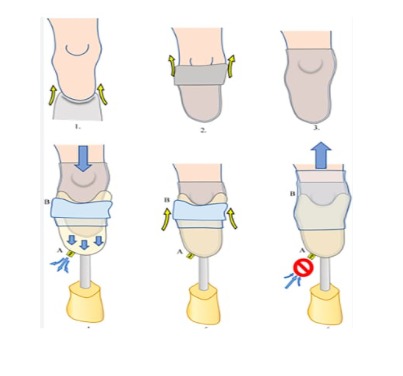
In this system, a silicone or gel liner creates the airtight seal instead of direct skin contact. The liner may have sealing rings or a membrane to maintain suction within the socket.
Advantages
- Even pressure distribution
- Secure and comfortable suspension
- Can be donned while seated
- Helps stabilize soft tissue
- Maintains suspension despite minor volume changes
Disadvantages
- Higher cost
- Liner wear and maintenance required
- Reduced effectiveness with major volume fluctuations
- Requires good hand strength and use of lubricant
In this system, a silicone or gel liner creates the airtight seal instead of direct skin contact. The liner may have sealing rings or a membrane to maintain suction within the socket.
Choosing the Right Prosthetic Suspension System
- Activity level
- Residual limb shape and condition
- Volume fluctuation
- Hand dexterity and strength
- Personal comfort and lifestyle needs
A well-chosen prosthetic suspension system improves mobility, reduces skin problems, and enhances long-term prosthesis use.
Frequently Asked Questions (FAQs)
Q1. What is a prosthetic socket?
Ans: A prosthetic socket is the part of an artificial limb that fits over the residual limb. It connects the body to the prosthesis and helps in support and control.
Q2. Why is the prosthetic socket so important?
Ans: The socket is important because it affects comfort, stability, and movement. A poorly fitting socket can cause pain, skin problems, and difficulty in walking or using the limb.
Q3. What are the main types of prosthetic sockets?
Ans: Common types include Patellar Tendon Bearing (PTB), Total Surface Bearing (TSB), Quadrilateral, and Ischial Containment sockets.
Q4. What is the difference between PTB and TSB sockets?
Ans: PTB sockets place pressure on specific load-bearing areas, while TSB sockets distribute pressure evenly over the entire residual limb.
Q5. How is a prosthetic socket design chosen?
Ans: The socket design is chosen based on the patient’s residual limb shape, activity level, body weight, skin condition, and comfort needs.
Q6. Is one socket design suitable for all patients?
Ans: No, each prosthetic socket is custom-made because every residual limb is different.
Q7. What materials are used to make prosthetic sockets?
Ans: Common materials include thermoplastics, carbon fiber, fiberglass, and silicone liners.
Q8. What problems can occur with an improper socket fit?
Ans: Problems may include pain, pressure sores, skin irritation, excessive sweating, and poor control of the prosthesis.
Q9. How often does a prosthetic socket need adjustment or replacement?
Ans: A socket may need adjustment if the limb size changes or discomfort occurs. Replacement is usually required after a few years or due to physical changes.
Q10. How does a good socket design improve a patient’s quality of life?
Ans: A well-designed socket improves comfort, mobility, and confidence, making daily activities easier and safer.