

Summary: Prosthetic limbs play a vital role in restoring mobility, independence, and confidence for individuals with limb loss. However, upper limb and lower limb prosthetics serve very different purposes and are designed to address unique functional needs. While upper limb prosthetics focus on restoring hand and arm function for daily tasks, lower limb prosthetics are primarily designed to support standing, walking, balance, and mobility. Understanding these differences can help individuals make informed decisions about their prosthetic care and rehabilitation journey.
Advancements in prosthetic technology have transformed the lives of millions of people around the world. Modern prosthetic devices help individuals regain independence, return to work, participate in recreational activities, and improve their overall quality of life.
Although all prosthetic limbs share the common goal of restoring function after limb loss, upper limb and lower limb prosthetics are fundamentally different in design, purpose, and rehabilitation requirements. Each type is developed to meet specific physical and functional demands.
For someone exploring prosthetic options for themselves or a loved one, understanding these distinctions is essential. The right prosthetic solution depends on various factors, including the level of amputation, lifestyle goals, activity level, and personal preferences.
This guide explains the key differences between upper limb and lower limb prosthetics, how they function, and what users can expect throughout their rehabilitation journey.
What Are Upper Limb Prosthetics?
Upper limb prosthetics are artificial devices designed to replace all or part of a missing arm, hand, wrist, or fingers.
The primary purpose of an upper limb prosthetic is to restore the ability to perform tasks that require reaching, grasping, holding, lifting, and manipulating objects.
These prosthetics help individuals regain function in everyday activities such as eating, writing, typing, dressing, cooking, and using tools.
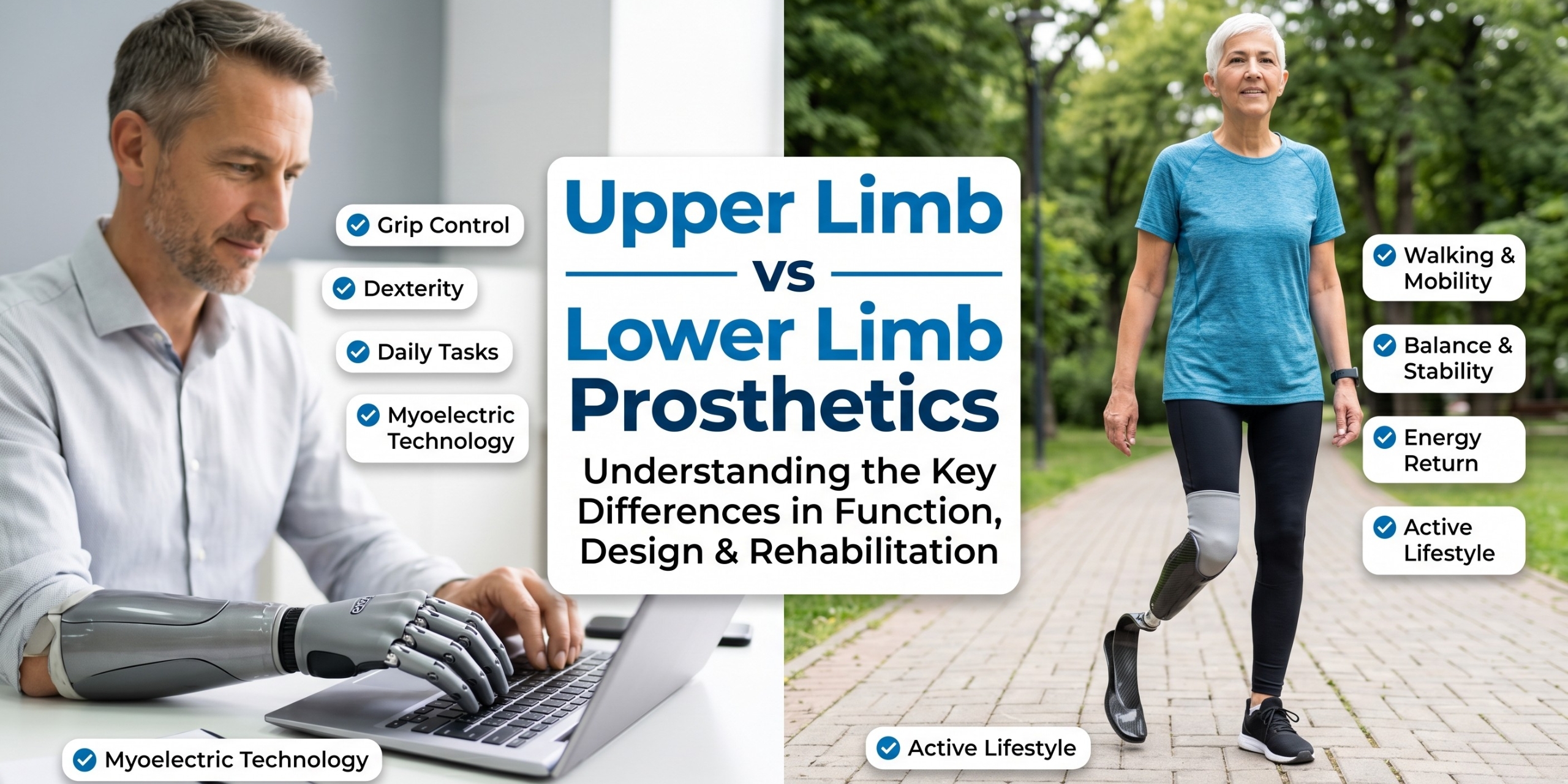
Depending on the level of limb loss and functional goals, upper limb prosthetics can range from simple passive devices to highly advanced myoelectric systems capable of multiple grip patterns and precise movements.
What Are Lower Limb Prosthetics?
Lower limb prosthetics are designed to replace missing portions of the leg, foot, ankle, or knee.
Unlike upper limb devices, which focus on manipulation and dexterity, lower limb prosthetics primarily support mobility, balance, and weight-bearing activities.
The main objectives of lower limb prosthetics are to:
- Restore walking ability
- Improve stability
- Enhance balance
- Support daily movement
- Promote independence
These devices enable users to navigate various environments and participate in activities ranging from routine walking to competitive sports.
Difference in Primary Function
One of the most significant distinctions between upper and lower limb prosthetics is their primary function.
Upper Limb Prosthetics Focus on Dexterity
The human hand is capable of performing highly complex movements. Because of this, upper limb prosthetics are designed to help users manipulate objects and perform fine motor tasks.
Users often require precise control to:
- Hold a pen
- Use a smartphone
- Button clothing
- Handle utensils
- Operate equipment
The challenge lies in recreating as much hand and arm functionality as possible.
Lower Limb Prosthetics Focus on Mobility
Lower limb prosthetics are designed to support body weight and facilitate movement.
Their primary goal is to help users:
- Stand comfortably
- Walk efficiently
- Climb stairs
- Navigate uneven surfaces
- Maintain balance
The emphasis is placed on stability, endurance, and mobility rather than fine motor control.
Differences in Design
Because upper and lower limbs perform different roles, their prosthetic designs differ significantly.
Upper Limb Design
Upper limb prosthetics often include:
- Prosthetic hands
- Fingers
- Wrists
- Elbows
- Control systems
Many modern devices feature advanced grip mechanisms and electronic controls that enable more natural movement.
The design prioritizes precision, flexibility, and object manipulation.
Lower Limb Design
Lower limb prosthetics typically consist of:
- Socket
- Suspension system
- Pylon
- Prosthetic foot
- Knee components (for above-knee amputations)
These components are engineered to withstand body weight and repetitive movement while maintaining comfort and stability.
Technology and Control Systems
Technological advancements have improved both upper and lower limb prosthetics, but the focus differs.
Technology in Upper Limb Prosthetics
Upper limb prosthetics often rely on sophisticated control systems.
Myoelectric prosthetics use electrical signals generated by muscles to control movements.
Advanced systems may include:
- Multiple grip patterns
- Individual finger movement
- Microprocessors
- Smart control features
The goal is to provide greater dexterity and functionality.
Technology in Lower Limb Prosthetics
Lower limb innovations focus on improving walking efficiency and balance.
Examples include:
- Microprocessor-controlled knees
- Energy-storing feet
- Carbon fiber components
- Dynamic response systems
These technologies help users walk more naturally and reduce fatigue.
Rehabilitation Differences
Rehabilitation plays a crucial role in prosthetic success, but the focus varies between upper and lower limb users.
Upper Limb Rehabilitation
Upper limb rehabilitation often emphasizes:
- Hand-eye coordination
- Grip training
- Object manipulation
- Muscle control
- Functional task practice
Occupational therapists typically guide users through exercises designed to improve daily living skills.
Learning to operate advanced prosthetic hands may require extensive training and practice.
Lower Limb Rehabilitation
Lower limb rehabilitation focuses on:
- Balance training
- Gait training
- Strength development
- Endurance building
- Mobility exercises
Physical therapists help users develop efficient walking patterns and improve overall stability.
The rehabilitation process often aims to restore confidence in movement and independence.
Energy Demands and Physical Effort
The physical demands associated with prosthetic use also differ.
Upper Limb Prosthetics
Using an upper limb prosthetic generally requires less overall energy expenditure but may involve greater mental concentration when learning new control systems.
Tasks requiring precision can take time to master.
Lower Limb Prosthetics
Lower limb prosthetics place greater physical demands on the body because they support walking and weight-bearing activities.
Individuals may initially experience:
- Muscle fatigue
- Increased energy expenditure
- Balance challenges
Over time, rehabilitation helps improve efficiency and reduce effort.
Daily Life Considerations
The impact of prosthetic use on daily life depends largely on the type of limb involved.
Daily Activities with Upper Limb Prosthetics
Upper limb users often focus on tasks involving:
- Personal care
- Household activities
- Work-related tasks
- Communication devices
- Recreation
Success is often measured by the ability to perform specific activities independently.
Daily Activities with Lower Limb Prosthetics
Lower limb users typically focus on mobility-related goals such as:
- Walking independently
- Returning to work
- Driving
- Traveling
- Participating in sports
Improved movement and accessibility are major priorities.
Customization and Personalization
Both upper and lower limb prosthetics require extensive customization.
Factors influencing customization include:
- Amputation level
- Lifestyle
- Occupation
- Activity level
- Personal goals
A construction worker may require a different prosthetic solution than an office professional, regardless of whether the prosthetic is for the upper or lower limb.
Customized devices generally provide better comfort, functionality, and long-term satisfaction.
Choosing the Right Prosthetic Solution
The best prosthetic solution depends on individual needs rather than technology alone.
Several factors should be considered:
Functional Goals
Understanding what activities are most important can help guide device selection.
Activity Level
More active users may benefit from advanced components designed for higher performance.
Comfort Requirements
A properly fitted prosthetic significantly improves long-term outcomes.
Rehabilitation Commitment
Successful prosthetic use requires ongoing training, adjustments, and support.
Working closely with an experienced prosthetist helps ensure the chosen device aligns with personal goals and expectations.
The Future of Prosthetic Care
The future of prosthetics continues to be shaped by innovation.
Researchers are developing technologies that improve:
- Sensory feedback
- Artificial intelligence integration
- Robotic movement
- Brain-computer interfaces
- 3D-printed customization
These advancements promise even greater functionality and independence for both upper and lower limb prosthetic users.
Finding the Right Path to Independence
While upper limb and lower limb prosthetics serve different purposes, both are designed to help individuals regain independence and improve quality of life. Upper limb prosthetics focus on restoring dexterity and daily task performance, while lower limb prosthetics prioritize mobility, balance, and movement.
Understanding these key differences helps patients, families, and caregivers make informed decisions about prosthetic care and rehabilitation. With modern technology, personalized fitting, and professional support, individuals with limb loss can achieve remarkable outcomes and continue pursuing their personal and professional goals.
Discover Advanced Prosthetic Solutions with PROACTIVE Technical Orthopaedics
At PROACTIVE Technical Orthopaedics, we are committed to helping individuals regain confidence and independence through innovative prosthetic care. As the best prosthetics supplier in India, we provide customized upper and lower limb prosthetic solutions tailored to each patient’s unique needs and lifestyle.
From advanced myoelectric hands to high-performance lower limb prosthetics, our team combines cutting-edge technology, expert fitting, and comprehensive rehabilitation support to deliver exceptional results. Contact PROACTIVE Technical Orthopaedics today to learn how we can help you take the next step toward greater mobility and independence.