

Summary: Learn how to select the perfect prosthetic limb tailored to your daily activities, mobility goals, and personal lifestyle, ensuring maximum comfort, functionality, and long-term independence.
No two amputees have the exact same journey, and consequently, no two prosthetic limbs should be identical. Selecting the right artificial limb is one of the most critical decisions in your rehabilitation process. It is not just about replacing a missing body part; it is about finding a mechanical extension of your body that seamlessly integrates with your daily routine, career demands, and recreational passions.
Whether your goal is to navigate your home safely, return to a physically demanding job, or compete in marathons, the technology exists to support you. By evaluating your activity levels and understanding how these devices function, you and your prosthetist can design a customized solution that empowers you to live life on your own terms.
Understanding Your Activity Level (The K-Level System)
In the world of prosthetics, especially for lower limbs, medical professionals use a classification system called “K-Levels” to measure a patient’s rehabilitation potential and current activity level. This rating directly influences the type of components (like feet and knees) that will be prescribed.
K-Level 1: Household Ambulation
The user has the ability or potential to use a prosthesis for transfers or walking on level surfaces at a fixed, slow pace. The ideal prosthetic for this level is lightweight, prioritizes high stability, and features a basic, yielding foot to prevent falls indoors.
K-Level 2: Limited Community Ambulation
The user can traverse low-level environmental barriers such as curbs, stairs, or uneven surfaces. Prosthetics for this group offer slightly more flexibility and energy return, allowing the user to navigate grocery stores or neighborhood sidewalks comfortably.
K-Level 3: Community Ambulation
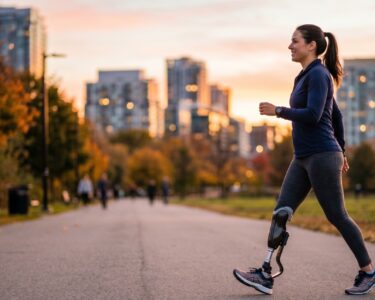
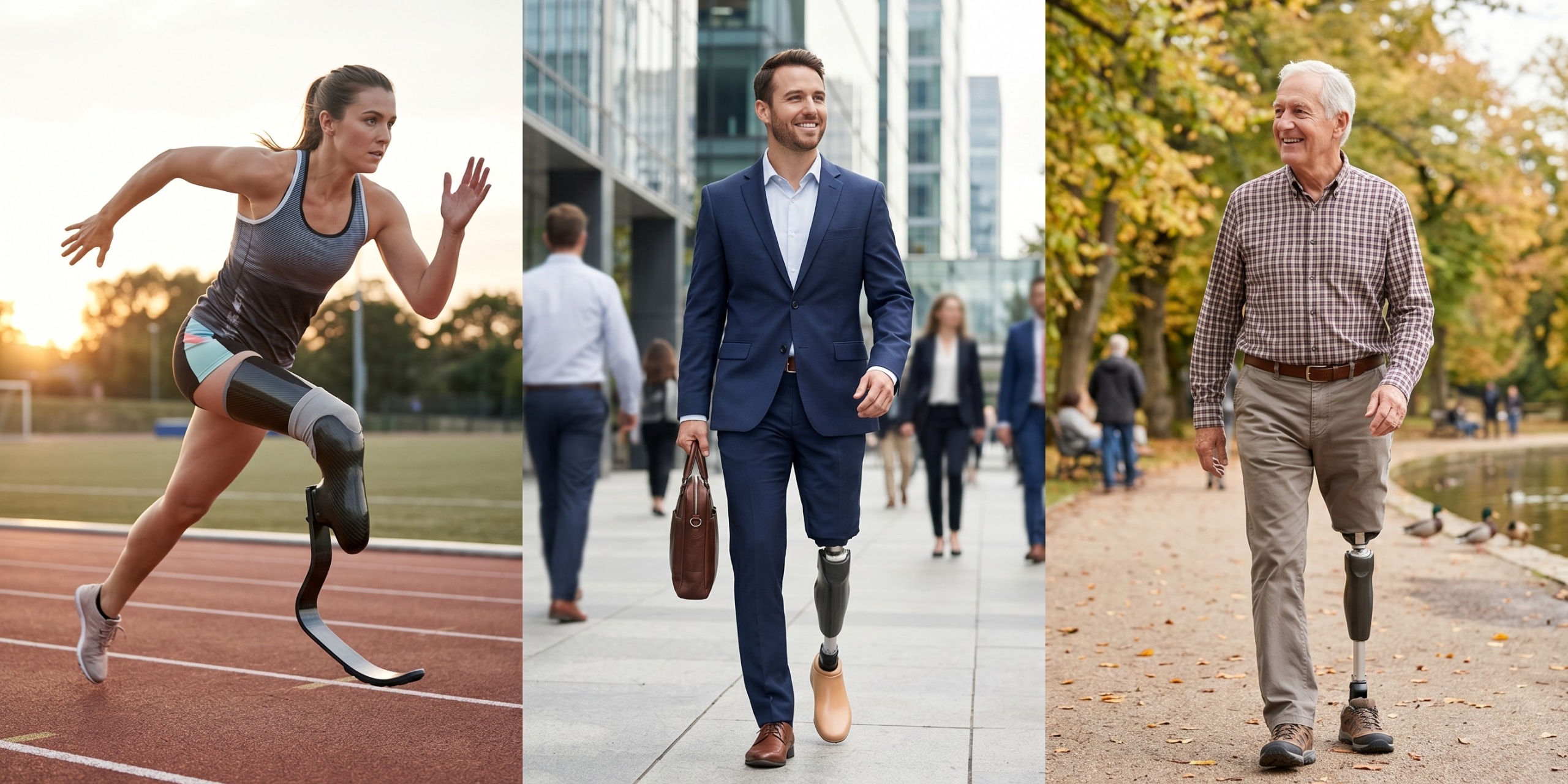
The user has the ability to walk at variable speeds and bypass most environmental barriers. This category includes people who work active jobs or engage in light sports. For these users, an advanced artificial knee joint (such as a microprocessor knee) or a dynamic carbon-fiber foot is often recommended to handle shifting terrains and faster paces.
K-Level 4: High Activity and Sports
The user exceeds basic walking skills, requiring a prosthesis capable of high impact, stress, or energy levels (typical of children, active adults, or athletes). These individuals require specialized running blades, heavy-duty shock absorbers, and highly responsive components.
Matching Prosthetic Technology to Your Lifestyle
Once your activity level is established, you must look at the specific demands of your day-to-day life to select the right components and materials.
For the Office Worker and Everyday User
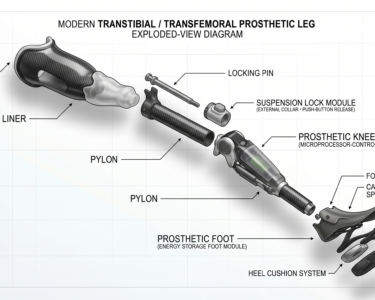
If your day consists mostly of commuting, sitting at a desk, and navigating flat environments, comfort and energy efficiency are your top priorities. A well-fitted custom-molded receptacle (the socket) is crucial for long hours of wear. For below-knee amputees, a standard transtibial prosthesis with a basic energy-returning foot provides a smooth, natural gait without unnecessary bulk or complexity.
For the Manual Laborer
If you work in construction, agriculture, or a warehouse, your prosthesis must be exceptionally durable.
- Upper Limb: A heavy-duty body-powered hook might be preferred over a fragile robotic hand because it can withstand dirt, heavy lifting, and rough impacts.
- Lower Limb: You will need a heavy-duty pylon and a multi-axial foot that can adapt to uneven ground, gravel, and scaffolding while supporting heavy loads.
For the Tech-Enthusiast and Multi-Tasker
If you require high dexterity for fine motor tasks, or simply want the most natural, intuitive movement possible for an upper extremity prosthesis, advanced electronics are the answer. Many turn to bionic prosthetics (myoelectric limbs) that read muscle signals to control individual robotic fingers, allowing for tasks like typing, cooking, or holding a delicate glass.
For the Swimmer and Outdoor Adventurer
Standard prosthetics cannot get wet—their metal parts rust and their microprocessors short-circuit. If you love the beach, swimming, or fishing, you will need a dedicated “water leg.” These are built entirely from waterproof plastics, titanium, and specialized treads to provide grip on slippery pool decks or ocean rocks.
Start Your Rehabilitation Journey!
Finding the right prosthetic solution is a deeply personal process that requires expert clinical guidance. If you or a loved one are navigating life after an amputation, it is essential to partner with a trusted engineering and clinical team to explore custom-designed devices tailored precisely to your goals and lifestyle.
To explore cutting-edge, internationally recognized prosthetic technology designed and fitted right here in India, connect with the best prosthetics manufacturer in india. Their team specializes in high-performance bionic limbs, microprocessor knees, and customized socket fabrications engineered to help you reclaim your mobility and independence. Reach out to a specialized prosthetic specialist today to discover how modern technology can transform your rehabilitation journey.
Frequently Asked Questions (FAQs)
1. Can I use the same prosthetic limb for walking and running?
Generally, no. While high-activity everyday prosthetics can handle a light jog, serious running requires a dedicated sports prosthesis (like a carbon-fiber running blade) designed specifically to absorb high-impact shocks and return maximum energy.
2. How do I know which K-Level I am?
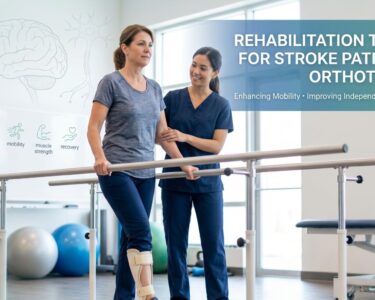
Your prosthetist and physical therapist will conduct a standardized mobility assessment. They will evaluate your balance, stride length, walking speed, and ability to navigate obstacles to determine your official K-Level.
3. Can I have more than one prosthetic limb?
Yes, many active individuals have multiple prostheses. For example, you might have an everyday walking leg, a waterproof leg for showering or swimming, and a specialized running blade. This depends on your medical necessity and insurance/funding options.
4. Are bionic arms suitable for heavy manual labor?
Typically, no. While myoelectric (bionic) arms offer incredible dexterity and a natural appearance, their internal motors and sensors are delicate. For heavy, dirty, or highly impact-driven labor, a durable body-powered hook is usually recommended.
5. Can I drive a car with a prosthetic limb?
Yes. Many amputees drive safely. Depending on which limb is amputated, you may be able to drive a standard automatic vehicle, or you may need to install specialized adaptive hand controls in your car.
6. Do I need a special prosthesis to wear high heels?
Yes. Standard prosthetic feet are set to a specific heel height (usually for flat shoes or sneakers). If you want to wear high heels, you will need an adjustable-heel prosthetic foot that allows you to change the ankle angle based on the shoe you are wearing.
7. How heavy is a typical prosthetic limb?
Modern prosthetics are surprisingly light, often made from carbon fiber, titanium, and advanced plastics. A typical lower-limb prosthesis weighs between 3 to 6 pounds (1.3 to 2.7 kg), which is actually significantly lighter than the biological limb it replaces.
8. Will I be able to feel the ground with my prosthesis?
While you won’t have biological touch sensation, you will experience “proprioception.” You will learn to feel the vibrations and pressures transferring through the prosthetic pylon and socket into your residual limb, which tells you what kind of surface you are walking on.
9. What should I do if my lifestyle changes and I become more active?
Prosthetics are modular. If you become more active (e.g., moving from a K2 to a K3 level), your prosthetist can often upgrade your terminal device (like swapping a basic foot for a dynamic carbon-fiber one) without having to build an entirely new socket.
10. How often will I need to replace my prosthetic limb?
While the socket may need to be replaced or adjusted every 1 to 3 years due to changes in your residual limb’s shape, the mechanical components (knees, feet, pylons) typically last 3 to 5 years depending on your activity level and routine maintenance.