

Summary: Prosthetic limbs restore mobility and independence for millions of people worldwide. But prosthetic legs and prosthetic arms serve fundamentally different purposes and are built with distinct technologies. This blog breaks down the key differences to help patients, caregivers, and curious readers understand what sets them apart.
Losing a limb is a life-changing experience, but advances in prosthetic technology have made it possible to reclaim independence and quality of life. Whether you or a loved one is recovering from an amputation, or you’re simply curious about how these devices work, understanding the difference between prosthetic legs and prosthetic arms is a great first step. While both devices aim to replace lost function, they differ significantly in design, mechanics, control systems, and rehabilitation requirements.
1. Primary Function and Goal
Prosthetic Leg (Lower Limb Prosthesis)
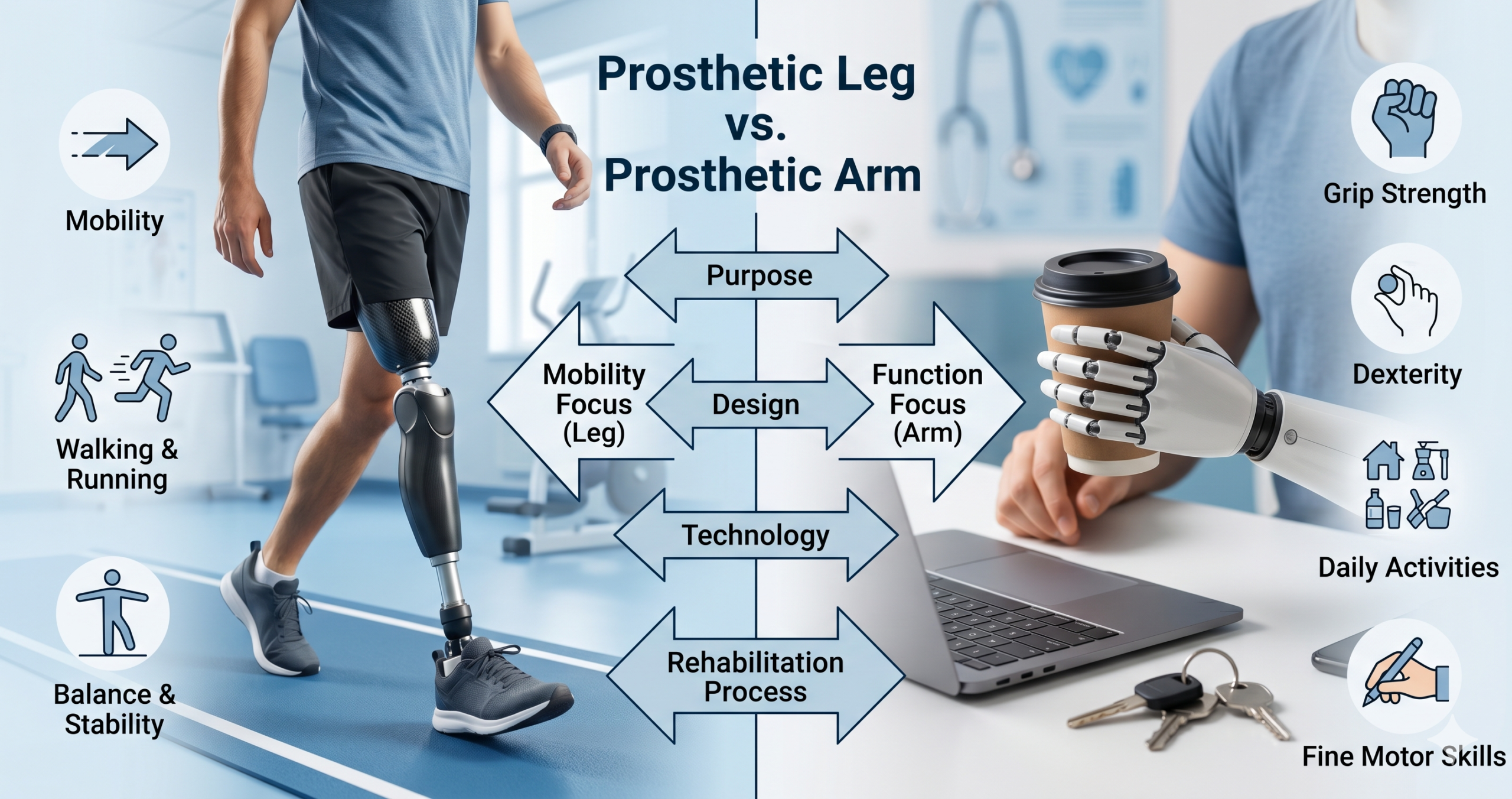
A prosthetic leg primarily focuses on weight-bearing, balance, and locomotion. The primary objective is to help users walk, run, climb stairs, and maintain stability during daily activities. The design must withstand significant mechanical load — sometimes several times the user’s body weight.
Prosthetic Arm (Upper Limb Prosthesis)
A prosthetic arm is designed to restore reach, grip, and fine motor function. Rather than supporting body weight, it focuses on precision and dexterity — tasks like picking up objects, typing, or holding a glass. The challenge here is replicating the extraordinary complexity of natural hand and arm movement.
2. Types of Devices
Types of Prosthetic Legs
Below-knee (transtibial): Replaces the limb from below the knee. Above-knee (transfemoral): Includes a prosthetic knee joint. Hip disarticulation: Replaces the entire leg from the hip socket. Knee disarticulation: Prosthetic replaces from just above the knee.
Types of Prosthetic Arms
Below-elbow (transradial): Replaces the forearm and hand. Above-elbow (transhumeral): Includes an elbow joint. Shoulder disarticulation: Full arm replacement from the shoulder. Partial hand prostheses: Replace individual fingers or portions of the hand.
3. Technology and Control Systems
Prosthetic Leg Technology
Modern prosthetic legs use microprocessor-controlled knees, carbon fibre energy return feet, hydraulic ankles, and osseointegration (direct bone implants). Myoelectric signals are increasingly used in advanced designs. Running blades like the Cheetah have made athletic performance possible.
Prosthetic Arm Technology
Prosthetic arms may be body-powered (using cables controlled by shoulder/body movement), myoelectric (using muscle signals detected via surface electrodes), or hybrid systems combining both. Bionic hands like the i-limb offer individual finger control, and research is advancing toward thought-controlled prosthetics using neural interfaces.
4. Rehabilitation Requirements
Rehabilitation for prosthetic legs typically emphasizes gait training, balance exercises, and strength building. Users often see functional improvement more quickly because walking is a well-understood biomechanical process.
Arm prosthetic rehabilitation is often more complex and lengthy. Learning to control fine motor movements requires extensive occupational therapy and muscle retraining, especially for myoelectric devices.
5. Psychological and Cosmetic Considerations
Both types of prosthetics come in functional and cosmetic versions. Many users choose a combination. Arm prosthetics tend to receive more focus on realistic appearance because hands and arms are highly visible and central to social interaction. Leg prosthetics, especially athletic blades, are increasingly being worn visibly as a symbol of identity and strength.
Frequently Asked Questions (FAQs)
Q1: Which is harder to adapt to — a prosthetic leg or a prosthetic arm?
Both have unique challenges. Prosthetic legs can be harder on the body physically due to weight-bearing demands, while prosthetic arms require extensive neural and cognitive retraining for fine motor tasks.
Q2: Can prosthetic limbs feel sensation?
Currently, most prosthetics do not transmit sensation, but emerging research in sensory feedback technology is making progress. Some experimental bionic limbs can now convey limited tactile feedback to the user.
Q3: How long does it take to get used to a prosthetic limb?
It varies. Simple prosthetic legs may take weeks for basic walking; advanced myoelectric arms can require months of therapy to use proficiently.
Q4: Are prosthetics covered by insurance in India?
Coverage varies by policy. Some government schemes like ADIP (Assistance to Disabled Persons) provide financial support. Consult your insurer or a specialist clinic for guidance.
Q5: What is osseointegration and is it available for both arms and legs?
Osseointegration is a procedure where a titanium implant is embedded directly into the bone, providing a stable attachment for the prosthetic. It is available for both lower and upper limb amputees and can significantly improve comfort and control.
Ready to Take the Next Step?
At PROACTIVE Technical Orthopaedics Pvt. Ltd., we specialize in providing advanced, customized prosthetic solutions tailored to your unique lifestyle and goals. Our team of experienced orthopaedic professionals is here to guide you every step of the way — from consultation to rehabilitation and beyond.
Contact PROACTIVE Technical Orthopaedics Pvt. Ltd. today — because every step matters.