

Summary: Choosing a prosthetic device is a deeply personal decision that depends on your activity level, amputation level, budget, and long-term goals. This guide helps you ask the right questions and work with your clinical team to find the best fit for your life.
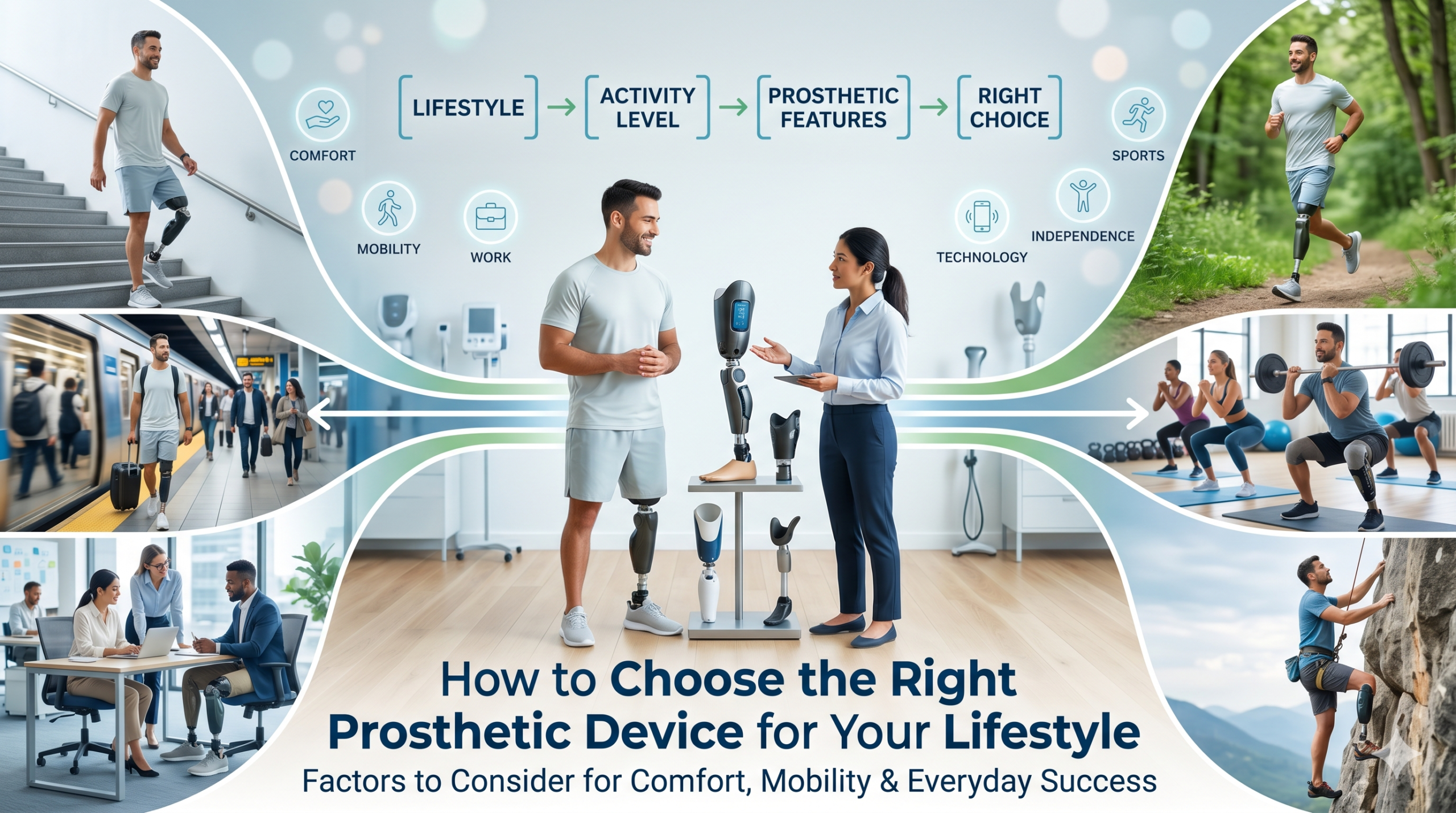
No two amputees are the same. A competitive athlete, a desk-based professional, a homemaker, and a senior citizen all have vastly different needs from a prosthetic device. With the wide variety of prosthetic technologies available today — from basic mechanical devices to advanced microprocessor-controlled limbs — choosing the right one can feel overwhelming. This guide walks you through the key factors to consider when selecting a prosthetic device tailored to your specific lifestyle.
1. Understand Your Amputation Level and Residual Limb
The starting point for any prosthetic selection is your amputation type. The level (transtibial, transfemoral, transradial, etc.) and the length and health of your residual limb directly determine which prosthetic components are compatible. A well-healed, well-shaped residual limb generally allows for a broader range of prosthetic options.
2. Assess Your Activity Level
K-Level Classification (Lower Limb)
In lower limb prosthetics, the K-level system classifies users by their functional potential: K0 (non-ambulatory), K1 (household ambulator), K2 (limited community), K3 (community ambulator), and K4 (high-activity/athletic). Your K-level directly influences which prosthetic feet, knees, and sockets are prescribed.
Upper Limb Considerations
For upper limb users, consider the tasks you perform most often — are they heavy manual tasks, precision tasks like writing, or primarily social/cosmetic? This guides the choice between body-powered, myoelectric, or passive prosthetics.
3. Lifestyle and Daily Activities
Think through your typical day: Do you drive? Cook? Play sports? Work outdoors? Different prosthetic systems perform differently across activities. For instance, waterproof prosthetics are essential for those who swim or work in wet environments. Carbon fibre running blades are ideal for active users. Microprocessor knees offer superior stumble recovery for those on uneven terrain.
4. Budget and Funding Options
Prosthetic costs in India range from a few thousand rupees for basic mechanical devices to several lakhs for advanced bionic limbs. Funding sources include personal insurance, employer disability benefits, government schemes (ADIP, NHFDC loans), NGO support, and corporate CSR initiatives. Your prosthetist can advise on cost-effective options that meet your functional needs.
5. Work With Your Clinical Team
A certified prosthetist-orthotist, physiatrist, and physiotherapist should all be part of your decision-making process. Trial periods and simulation fittings can help you evaluate how a device fits into your lifestyle before committing. Don’t hesitate to ask for a second opinion.
6. Cosmesis vs. Function: Finding the Balance
Some users prioritize a natural-looking limb for social confidence, while others focus entirely on function. Many modern devices offer both. Silicone cosmetic covers can be added to functional prosthetics, and myoelectric hands now closely resemble natural skin tones and textures.
7. Plan for Growth and Change
Your needs will evolve. A young active user may need upgrades as they age or as technology improves. Children require regular socket replacements as they grow. Choose a provider who can offer long-term support, adjustments, and upgrades.
Frequently Asked Questions (FAQs)
Q1: Can I try a prosthetic before buying it?
Yes — most certified prosthetic clinics offer trial fittings or loaner devices. This is especially common for higher-end devices and is strongly recommended before making a final decision.
Q2: Should I get a microprocessor knee or a mechanical knee?
It depends on your K-level and lifestyle. K3 and K4 users (community ambulators and athletes) typically benefit most from microprocessor knees, while K2 users may do well with advanced mechanical designs. Your prosthetist will guide you.
Q3: How often will I need a new prosthetic socket?
Sockets typically need replacement every 1–3 years as your residual limb changes shape. Younger, more active users may need more frequent socket replacements.
Q4: What should I do if my prosthetic is uncomfortable?
Never ignore discomfort. Contact your prosthetist promptly. Discomfort often indicates socket fit issues, skin problems, or component misalignment — all of which are correctable with professional adjustment.
Q5: Is a myoelectric prosthetic arm right for everyone?
Not necessarily. Myoelectric arms require strong, consistent muscle signals, good skin condition, and intensive training. They are excellent for many users but may not be ideal for everyone. Your clinical team can assess your suitability.
Ready to Take the Next Step?
At PROACTIVE Technical Orthopaedics Pvt. Ltd., we specialize in providing advanced, customized prosthetic solutions tailored to your unique lifestyle and goals. Our team of experienced orthopaedic professionals is here to guide you every step of the way — from consultation to rehabilitation and beyond.
Contact PROACTIVE Technical Orthopaedics Pvt. Ltd. today — because every step matters.