
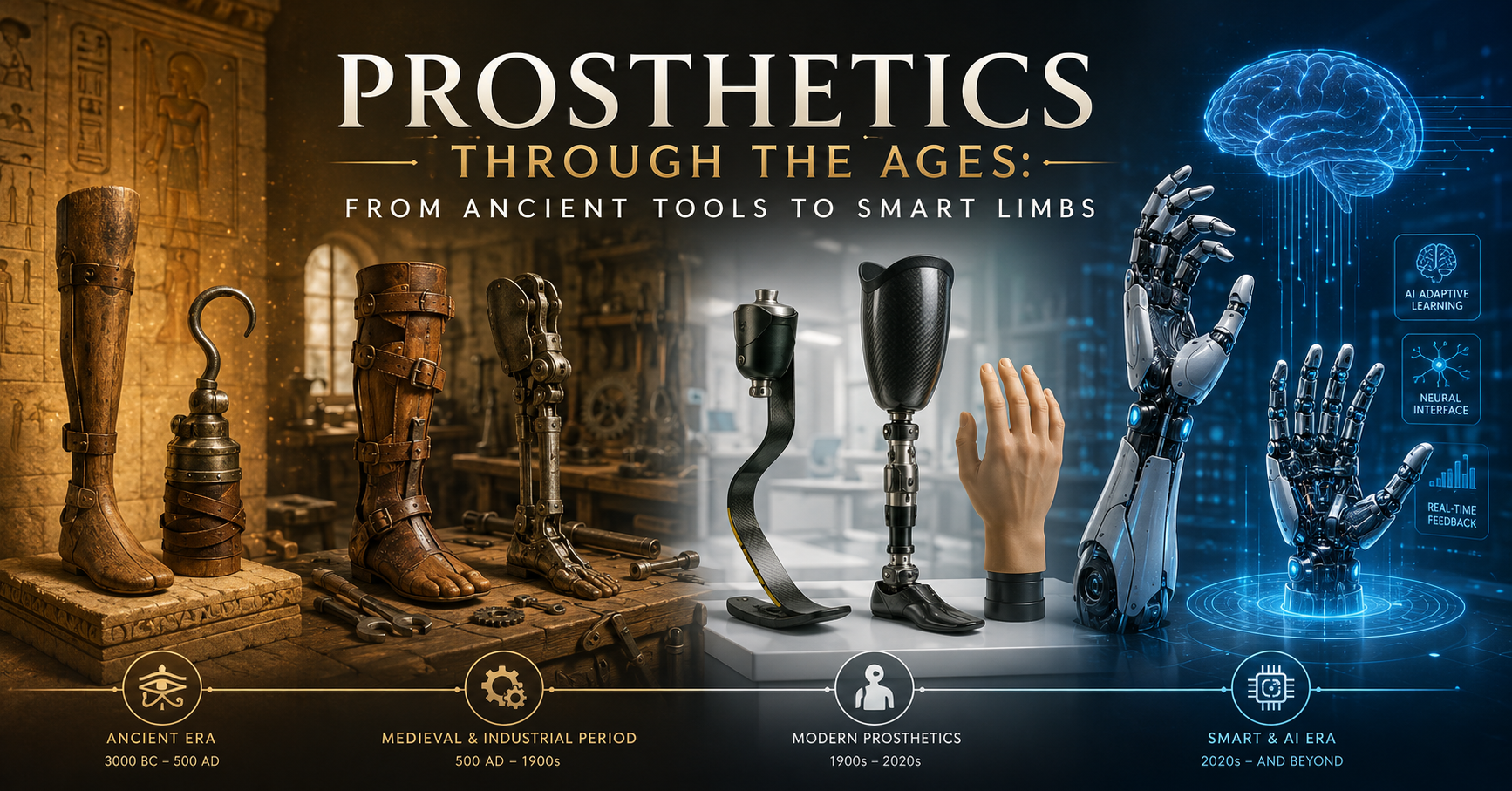

Summary: Prosthetics have developed from hand-shaped wooden toes and heavy metal limbs into lightweight, sensor-controlled devices that can respond to movement in real time. This guide follows the major stages of prosthetic history, explains how wars, medicine, materials and engineering accelerated progress, and looks at the technologies shaping the next generation of artificial limbs.
The history of prosthetics is not simply a story about machines. It is a story about people finding practical ways to move, work, care for themselves and participate in society after limb loss. Every major step forward has tried to solve the same basic challenge: how can an artificial limb connect comfortably to the body and provide useful function?
Early devices were made from the materials people already understood, including wood, leather and metal. Modern prostheses may use carbon fibre, silicone, titanium, microprocessors, motors and digital sensors. The technology has changed dramatically, but comfort, reliability, personal goals and access remain just as important as innovation.
Why Humans Began Making Prostheses?
People have always adapted tools to the needs of the body. A prosthesis could serve several purposes: protecting a sensitive residual limb, restoring balance, improving walking, helping a person hold tools or weapons, or recreating a natural appearance.
Historical evidence is incomplete because wood, leather and fabric often decay. Surviving examples therefore show only part of the story. Some ancient devices may also have been ceremonial or cosmetic rather than functional. Researchers study wear marks, attachment systems and replicas to understand whether a device was actually used in daily life.
Ancient Prosthetics: The First Known Devices
Ancient Egyptian Toes
Two of the earliest known prosthetic body parts are artificial toes from ancient Egypt. The wooden-and-leather Cairo toe, dated to roughly 950–710 BCE, was attached to the foot of a woman. Its flexible construction and signs of wear suggest that it may have helped with walking, including while wearing traditional sandals.
Another example, often called the Greville Chester toe, was made from cartonnage, a material created from linen, glue and plaster. It was less flexible and may have served mainly a cosmetic purpose. Together, these examples show that ancient makers were already thinking about shape, attachment, appearance and function.
The Roman Capua Leg
A famous artificial leg associated with ancient Rome was found near Capua in Italy and dated to around 300 BCE. It had a wooden core with metal covering. The original was later destroyed during the Second World War, but a copy remains. Its structure suggests an effort to replace the lower leg and support the wearer rather than simply hide limb loss.
Ancient texts also describe warriors using artificial hands. These accounts are difficult to verify, but they demonstrate that prostheses were linked to work, military service and social identity from an early period.
The Middle Ages: Practical but Limited Designs
During the Middle Ages, most prostheses were individually made by armourers, leatherworkers or other craftspeople. Wealthy users could commission metal limbs shaped like armour, while simpler wooden pegs and hooks were more widely available.
These devices were often heavy and had limited movement. A peg leg could support standing and basic walking, but it could not reproduce ankle motion. A hook could hold reins, shields or tools, but fine hand movements were usually impossible. Comfort was also restricted because sockets and straps were not shaped using modern anatomical knowledge.
Even with these limitations, medieval prostheses offered practical independence. Their design reflected the wearer’s work, financial resources and place in society.
The Renaissance: Mechanics Enter Prosthetic Design
Götz von Berlichingen’s Mechanical Hands
German knight Götz von Berlichingen lost his right hand in the early 1500s and used sophisticated iron replacements. One of his mechanical hands had movable finger joints that could be locked into different positions. It was still heavy, but it showed how hinges, springs and catches could provide more than a fixed cosmetic shape.
Ambroise Paré and More Anatomical Limbs
French surgeon Ambroise Paré helped transform amputation surgery and prosthetic design during the sixteenth century. He described artificial arms and legs with articulated joints, locking knees and improved harnesses. He also promoted safer surgical methods, which increased the chances that a person would heal well enough to use a prosthesis.
This period established a pattern that continues today: better surgery, rehabilitation and prosthetic engineering work together. A technologically advanced limb cannot succeed if the residual limb is painful, poorly healed or unable to tolerate the socket.
The Industrial Age: Standardisation and Better Joints
Industrial manufacturing made stronger hinges, springs, fasteners and interchangeable parts possible. In the early nineteenth century, James Potts developed a leg with an articulated knee, ankle and foot linked by cords. A later version became known as the Anglesey leg after it was used by the Marquess of Anglesey.
Large numbers of people experienced limb loss during industrial accidents and wars, particularly the American Civil War. Demand encouraged workshops and companies to produce prostheses in greater numbers. Patents increased, component designs became more standardised, and governments began supporting veterans who required artificial limbs.
However, access and quality varied widely. Many devices remained expensive, uncomfortable and difficult to repair. The industrial era improved production, but it also showed that a standard component must still be fitted to an individual body.
The World Wars and the Rise of Rehabilitation
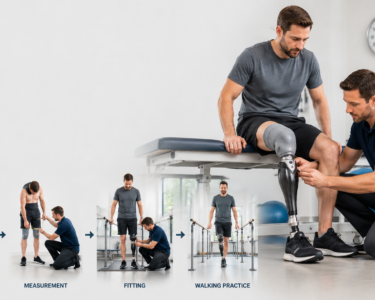
The First and Second World Wars created an urgent need for surgical care, rehabilitation and durable prosthetic systems. Teams began to include surgeons, prosthetists, therapists, engineers and vocational specialists. The goal expanded from replacing a missing body part to helping a person return to family life, employment and community participation.
After the Second World War, research programmes tested new socket designs, plastics, aluminium alloys and more functional knees and feet. Plastic laminates reduced some of the weight associated with wood and steel. Modular or endoskeletal designs later allowed clinicians to adjust alignment before applying a cosmetic cover.
The solid ankle cushioned heel, commonly called the SACH foot, became a widely used twentieth-century design. It did not contain a moving ankle joint, but its cushioned heel and flexible keel offered dependable rollover with relatively simple construction.
From Body-Powered Devices to Myoelectric Control
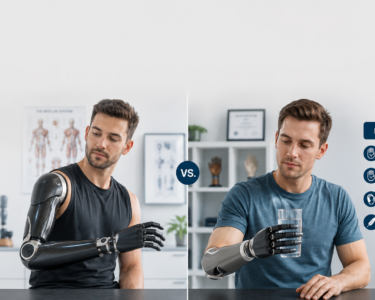
Upper-limb users traditionally controlled many functional prostheses through cables and a shoulder harness. Moving the shoulder or upper body pulled a cable that opened a hook or hand. Body-powered systems remain useful because they can be durable, relatively light and capable of providing some movement feedback through cable tension.
Myoelectric development accelerated after the Second World War. Electrodes placed against the skin detect electrical activity from remaining muscles. A controller interprets those signals and activates motors in a powered hand, wrist or elbow.
Modern myoelectric devices can offer several grip patterns and more natural-looking movement, although they may be heavier, require charging and need training. The choice between passive, body-powered and myoelectric systems depends on the user’s priorities rather than on which option appears most advanced.
Lightweight Materials Transform Comfort and Performance
Late twentieth-century prosthetics benefited from aerospace and composite-material engineering. Carbon fibre could store and return energy while remaining strong and relatively light. Titanium offered strength, corrosion resistance and a useful strength-to-weight ratio. Silicone and gel liners improved cushioning and suspension for many users.
Energy-storing prosthetic feet flex under load and release some of that energy as the user moves forward. Specialised running blades use the same general principle but are designed for sport rather than everyday walking. Learn more about this material in What Are Carbon Fiber Prosthetics?.
Digital scanning and computer-aided design have also changed how clinicians capture limb shape and prepare sockets. These tools can improve repeatability, but the final result still depends on careful clinical assessment, fitting and user feedback.
Smart Limbs and Microprocessor Control
The Intelligent Prosthesis entered the market in the early 1990s, followed by the C-Leg in 1997. These systems helped establish microprocessor-controlled knees as an important option for suitable above-knee users.
A microprocessor knee receives information from sensors and adjusts resistance during different parts of the gait cycle. Depending on the device, it may respond to walking speed, ramps, stairs, standing and unexpected changes in load. It does not make every movement automatic, and users still need appropriate strength, training and alignment.
Powered ankles and knees go further by using motors to add movement or propulsion. The additional function can improve specific tasks, but powered systems bring trade-offs involving weight, battery life, servicing, water resistance and cost.
For a closer look at this technology, visit Microprocessor Knee: Benefits and Features.
Bionic Hands, Pattern Recognition and Sensory Feedback
Multi-articulating hands use small motors to move individual fingers or groups of fingers. Pattern-recognition software can analyse combinations of muscle signals rather than relying only on one signal for opening and another for closing. This may allow more intuitive control after structured occupational therapy.
Researchers are also developing systems that return information to the nervous system. Sensors on a prosthesis may detect pressure, contact or joint position, while stimulation provides the user with a form of sensory feedback. Early studies suggest that feedback may improve control, confidence and the feeling that the prosthesis is part of the body.
Bionic Prosthetics: How They Work and Who They Help explains how current bionic systems differ from science-fiction expectations.
3D Printing, Osseointegration and Personalised Manufacturing
Three-dimensional printing can create test sockets, lightweight structures, covers and some upper-limb devices. It can reduce material waste and support rapid design changes, but a printed device still requires suitable materials, quality control and professional fitting. A low-cost printed hand and a load-bearing lower-limb socket have very different safety requirements.
Osseointegration uses an implant anchored in bone to connect an external prosthesis without a conventional socket. It may help selected users who cannot tolerate a socket, but it involves surgery, infection risk, lifelong skin-interface care and specialist follow-up.
The broader movement is toward personalisation. Activity data, pressure mapping, digital gait analysis and adjustable sockets can help clinicians match a device more closely to the user’s body, environment and goals.
What the Next Generation May Bring
Future prostheses are likely to combine several developments:
- Smaller and more efficient motors, batteries and sensors
- Artificial intelligence that recognises movement intentions and terrain
- More comfortable sockets that adjust to daily limb-volume changes
- Improved sensory feedback and nerve interfaces
- Remote monitoring that identifies fit or component problems early
- More affordable digital manufacturing and locally serviceable components
Innovation will be meaningful only when it is safe, maintainable and accessible. A smart limb that cannot be repaired locally or used in the wearer’s climate may offer less real-world value than a simpler, dependable system.
Explore additional developments in Key Innovations in Prosthetic Science and Technology.
From Replacement to a Personal Mobility System
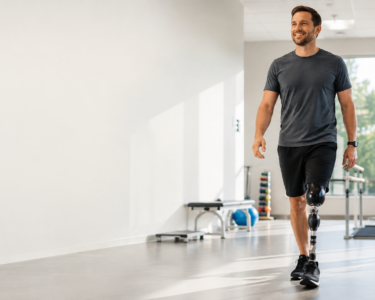
Prosthetic history has moved from fixed shapes to adjustable systems, from heavy external frames to lightweight modular components, and from passive support to real-time digital control. Yet there is no single “best” prosthesis for everyone. The right solution is the one that fits safely, supports meaningful activities and can be maintained over time.
The most important progress is therefore not technology alone. It is the growing understanding that prosthetic care must be built around the individual user, supported by skilled fitting, rehabilitation, training and long-term follow-up.
Explore Prosthetic Solutions with PROACTIVE
To discuss prosthetic components, fitting needs or clinical support, contact PROACTIVE Technical Orthopaedics. Their team in Pune works with prosthetic and orthotic products, rehabilitation providers and individuals seeking practical mobility solutions.
Frequently Asked Questions
1. What is the oldest known prosthetic limb?
Ancient Egyptian artificial toes are among the oldest confirmed prosthetic body parts. The wooden-and-leather Cairo toe dates to roughly 950–710 BCE and shows signs that suggest practical use, possibly helping its wearer walk while using sandals.
2. What materials were early prostheses made from?
Early makers used available materials such as wood, leather, cloth and metal. The choice depended on local craftsmanship, the wearer’s resources and the intended function. Metal could provide strength, while leather straps helped attach the device to the body.
3. Who is considered an important pioneer of prosthetics?
Ambroise Paré is a major historical figure because he improved both amputation care and prosthetic design in the sixteenth century. He described jointed limbs, locking mechanisms and harness systems while promoting surgical methods that improved healing.
4. When were myoelectric prosthetic arms developed?
Experimental electrical and externally powered limbs appeared in the twentieth century, with myoelectric research accelerating after the Second World War. Commercial systems developed over subsequent decades as electrodes, motors, batteries and control electronics became more practical.
5. What was the first commercial microprocessor knee?
Blatchford’s Intelligent Prosthesis entered the market around 1990 and is widely recognised as the first commercially available microprocessor-controlled prosthetic knee. Ottobock’s C-Leg followed in 1997 and helped expand the clinical use of this technology.
6. Are modern prostheses always better than older mechanical designs?
Not for every user or task. Modern electronics can improve control and adaptability, but they may add weight, cost, charging needs and maintenance. A simpler mechanical or body-powered system can be the better option when durability and easy repair are priorities.
7. How do smart prosthetic limbs work?
Smart prostheses use sensors to collect information about movement, load or muscle activity. A controller processes the data and adjusts a knee, ankle, hand or other component. Some devices only change resistance, while powered systems can actively produce movement.
8. Can a prosthetic limb provide a sense of touch?
Some research and specialised systems can provide limited sensory feedback by stimulating nerves or the skin in response to prosthetic sensors. This is a developing field and is not yet a routine feature in most everyday prostheses.
9. Is 3D printing suitable for every prosthetic component?
No. Suitability depends on the component, material, manufacturing process, user weight and expected loads. Cosmetic covers and some upper-limb devices may be easier to print safely than a weight-bearing socket. Professional design, testing and fitting remain essential.
10. What is the future of prosthetic technology?
The field is moving toward lighter motors, smarter controls, adjustable sockets, digital manufacturing, sensory feedback and more personalised rehabilitation. The strongest solutions will combine advanced function with comfort, affordability, repairability and long-term clinical support.