

Explore the distinction between prosthetic arms and hands, their specific functions, and when each is recommended for different amputation levels.
Upper-limb amputation can involve loss of fingers, hand, forearm, or entire arm. The terms ‘prosthetic arm’ and ‘prosthetic hand’ refer to different levels of prosthetics, each addressing specific functional challenges. Understanding these distinctions helps clarify your prosthetic options and expectations. Some people benefit from prosthetic hands alone, others from prosthetic arms with attached hands, and some use different prosthetics for different situations.
Understanding Amputation Levels
Finger amputation involves loss of one or more fingers. Partial hand amputation loses part of the hand but preserves some anatomical structure. Wrist disarticulation removes the hand but preserves the wrist and forearm. Transcarpal amputation removes the hand at the wrist level. Transradial (below-elbow) amputation removes the hand and part of the forearm. Transhumeral (above-elbow) amputation removes the hand, forearm, and part of the arm. Shoulder disarticulation removes the entire arm at the shoulder. Each level has different prosthetic implications. Lower amputations preserve more anatomical structure and typically have better functional outcomes. Higher amputations require replacing more functions, increasing prosthetic complexity.
What is a Prosthetic Hand?
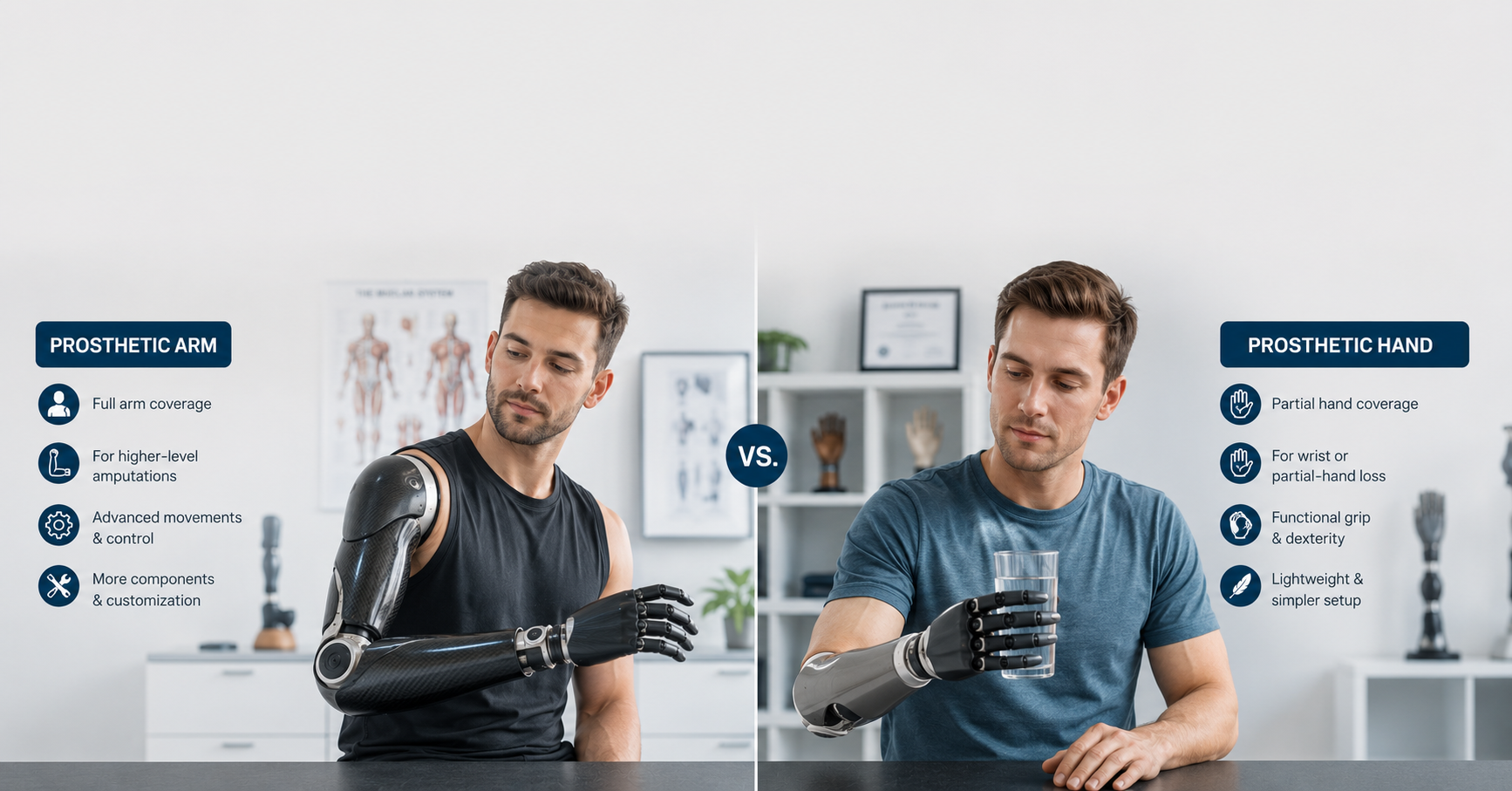
A prosthetic hand is an artificial device that replaces missing fingers or hand while preserving forearm function. Prosthetic hands consist of mechanical fingers that can grip, pinch, or hold objects. Body-powered hands use cables operated by shoulder/forearm movement. Myoelectric hands use electrical signals from arm muscles to operate motors controlling finger movement. Passive hands maintain whatever position they’re positioned in manually. Cosmetic hands prioritize appearance over function. Prosthetic hands connect at the wrist to your residual forearm. If you have a transradial amputation (forearm preserved), a prosthetic hand is appropriate. Prosthetic hands cost $2,000-$100,000 depending on sophistication, ranging from body-powered to advanced bionic options.
What is a Prosthetic Arm?
A prosthetic arm includes a prosthetic shoulder, elbow, and hand working as an integrated system. Prosthetic arms are necessary when amputation involves losing the elbow (transhumeral) or shoulder (shoulder disarticulation). These prosthetics must replace multiple joint functions—shoulder motion, elbow flexion/extension, wrist rotation, and hand function. Prosthetic arms are significantly more complex than prosthetic hands because they must provide more degrees of freedom and control. Body-powered arms use body movements to control shoulder, elbow, and hand sequentially. Myoelectric arms detect muscle signals to control each joint independently. Advanced prosthetic arms can coordinate multiple joints for complex movements. Prosthetic arms cost $10,000-$200,000 depending on technology level. Prosthetic arms require more extensive training and rehabilitation than prosthetic hands.
Functional Differences
Prosthetic hands, attached to a preserved forearm, allow precise hand control and good dexterity. You retain forearm rotation (pronation/supination), so you can turn your wrist. This preserved function enables tasks requiring hand dexterity—writing, typing, buttoning—with the hand prosthetic. Below-elbow amputees with myoelectric hands can achieve impressive precision and control. Prosthetic arms lack forearm preservation and must replace elbow function, limiting overall dexterity compared to prosthetic hands. However, prosthetic arms enable reaching to different distances, which prosthetic hands cannot do. Above-elbow amputees can lift objects to high shelves, reaching overhead, and positioning their hand at various distances. The trade-off is reduced precision for improved reach and positioning.
Control Systems and Complexity
Prosthetic hands typically offer simpler control than prosthetic arms because only hand function is being controlled. Body-powered hands require less training and adjustment. Myoelectric hands need one to three electrode sites—typically on the forearm flexors and extensors. Users learn to contract specific muscles to control hand opening/closing and grip patterns. Prosthetic arms are substantially more complex. Body-powered arms require sequential control—you position one joint at a time using body movements. Myoelectric arms use multiple electrode sites to control shoulder, elbow, wrist, and hand functions. Advanced prosthetic arms offer individual finger control and coordinated multi-joint movement. Training requirements are proportional to complexity; basic hand prosthetics require weeks of training, while advanced arm prosthetics require months.
Training and Rehabilitation Duration
Prosthetic hand training typically requires 4-8 weeks of dedicated therapy. You learn muscle control, basic manipulation tasks, and gradually progress to complex activities. Most people adapt to prosthetic hands relatively quickly because they’re controlling a single functional unit. Training focuses on precision, speed, and specific task practice. Prosthetic arm training is more intensive, typically requiring 8-16 weeks or longer. You must learn to control multiple joints sequentially or simultaneously. Training progresses from simple shoulder movements to coordinated elbow and hand function to complex bilateral tasks. Many people benefit from 6-12 months of practice to develop proficiency with prosthetic arms. The learning curve is steeper, but the increased reach and positioning capability justifies the training investment for many users.
Choosing Between Prosthetic Hand and Arm Options
If you have transradial amputation (forearm preserved), a prosthetic hand is the appropriate choice. Preserved forearm function combined with a prosthetic hand allows excellent functional outcomes. If you have transhumeral amputation (forearm lost), you require a prosthetic arm with integrated hand. Deciding between body-powered and myoelectric arms involves trade-offs between simplicity/reliability (body-powered) and intuitive control/function (myoelectric). Some people maintain multiple prosthetics—a body-powered arm for work and outdoor activities because it’s durable, and a myoelectric arm for office work where precision matters. Partial hand amputees may wear a prosthetic hand for formal occasions but go without for comfort at home. Discuss your specific situation, functional priorities, and lifestyle with your prosthetist to determine optimal prosthetic selection.
Real-World Functionality and Limitations
Prosthetic hands, especially myoelectric versions, enable impressive functional capabilities. Users can type, write, manipulate small objects, shake hands, and perform many precision tasks. However, even advanced prosthetic hands are slower than biological hands—a task taking 5 seconds with your biological hand might take 15-30 seconds with a prosthetic. Prosthetic arms enable good functional capability, including reaching and positioning at different distances. However, control is less intuitive and precise than prosthetic hands. Complex bilateral tasks requiring coordination between hands remain challenging. Most prosthetic arm users achieve functional capability adequate for work and daily activities but acknowledge limitations compared to biological function. Realistic expectations about what’s possible prevent frustration and disappointment.
Optimizing Your Upper-Limb Prosthetic Selection
Next Steps With Proactive Technical Orthopaedics
Upper-limb amputation presents unique challenges requiring expert solutions. Proactive Technical Orthopaedics, recognized as India’s best prosthetics manufacturer, specializes in prosthetic arms and hands with cutting-edge technology. Our specialists help you regain function and confidence. Schedule your consultation today.
Frequently Asked Questions
1. What Is The Difference Between A Prosthetic Arm And A Prosthetic Hand?
A prosthetic arm replaces a larger portion of the upper limb, while a prosthetic hand is primarily designed to replace the hand itself. The choice depends on the level of limb loss, functional requirements, comfort, and individual needs.
2. Is A Prosthetic Hand Better Than A Prosthetic Arm?
Neither option is universally better. A prosthetic hand may be suitable when the loss is limited to the hand, while a prosthetic arm may be required when the amputation extends above the wrist or elbow. A prosthetist can recommend the appropriate option based on your condition and goals.
3. What Types Of Prosthetic Hands Are Available?
Prosthetic hands can include passive, body-powered, and myoelectric designs. Passive hands are mainly used for appearance and support, while body-powered and myoelectric hands can provide different levels of grasping and functional movement.
4. What Types Of Prosthetic Arms Are Available?
Prosthetic arms may include below-elbow, above-elbow, and shoulder-level prostheses. They can use body-powered, myoelectric, or hybrid systems depending on the level of amputation and the user’s functional requirements.
5. How Does A Myoelectric Prosthetic Hand Work?
A myoelectric prosthetic hand uses electrical signals generated by remaining muscles to control movement. Sensors inside the prosthetic socket detect these signals and translate them into actions such as opening, closing, or changing the hand’s grip.
6. Can A Prosthetic Hand Move Like A Natural Hand?
Some advanced prosthetic hands can perform multiple movements and grip patterns, but they generally cannot reproduce all the movements, sensation, strength, and fine control of a natural hand. Training and proper fitting can help users make better use of available functions.
7. How Do I Choose Between A Prosthetic Arm And A Prosthetic Hand?
The decision depends on the level of amputation, muscle strength, lifestyle, work requirements, desired functions, comfort, and budget. A qualified prosthetist can assess these factors and recommend a suitable prosthetic solution.
8. Are Prosthetic Arms And Hands Comfortable To Wear?
Comfort depends largely on proper socket fitting, alignment, weight, suspension, and regular adjustments. A well-fitted prosthesis can be comfortable for daily use, but some users may need an adjustment period before wearing it for longer periods.
9. How Long Does It Take To Get Used To A Prosthetic Hand Or Arm?
The adjustment period varies from person to person. Users typically need time to learn how to control the prosthesis, perform everyday tasks, and build confidence. Occupational or prosthetic rehabilitation can help improve control and functional use.
10. How Much Does A Prosthetic Arm Or Hand Cost?
The cost varies depending on the type of prosthesis, materials, technology, level of amputation, customization, and components used. Basic prostheses generally cost less than advanced myoelectric or multi-articulating systems. A prosthetic specialist can provide a more accurate estimate after an assessment.