

Summary: Prosthetic socket pressure mapping uses thin sensors to measure how load is distributed between the residual limb and socket. It can reveal high-pressure areas, uneven contact and movement that may not be obvious during a short visual examination. This guide explains how mapping works, where it can improve fitting and rehabilitation, and why the results must be interpreted alongside skin condition, user feedback and gait assessment.
The socket is the part of a prosthesis that connects the user’s body to the artificial limb. It must transfer load securely enough for control while protecting skin and soft tissue that were not designed to carry body weight in this way.
Traditional socket fitting depends on anatomical knowledge, hands-on assessment, clinical experience and the user’s description of comfort. These remain essential. Pressure mapping adds another source of information by showing where and when pressure develops as the person stands, walks or completes other tasks.
This technology is especially valuable when symptoms occur only during movement, when discomfort is difficult to describe, or when sensation in the residual limb is reduced. It is not a pass-or-fail test and does not produce one universal “perfect” pressure pattern.
What Is Socket Pressure Mapping?
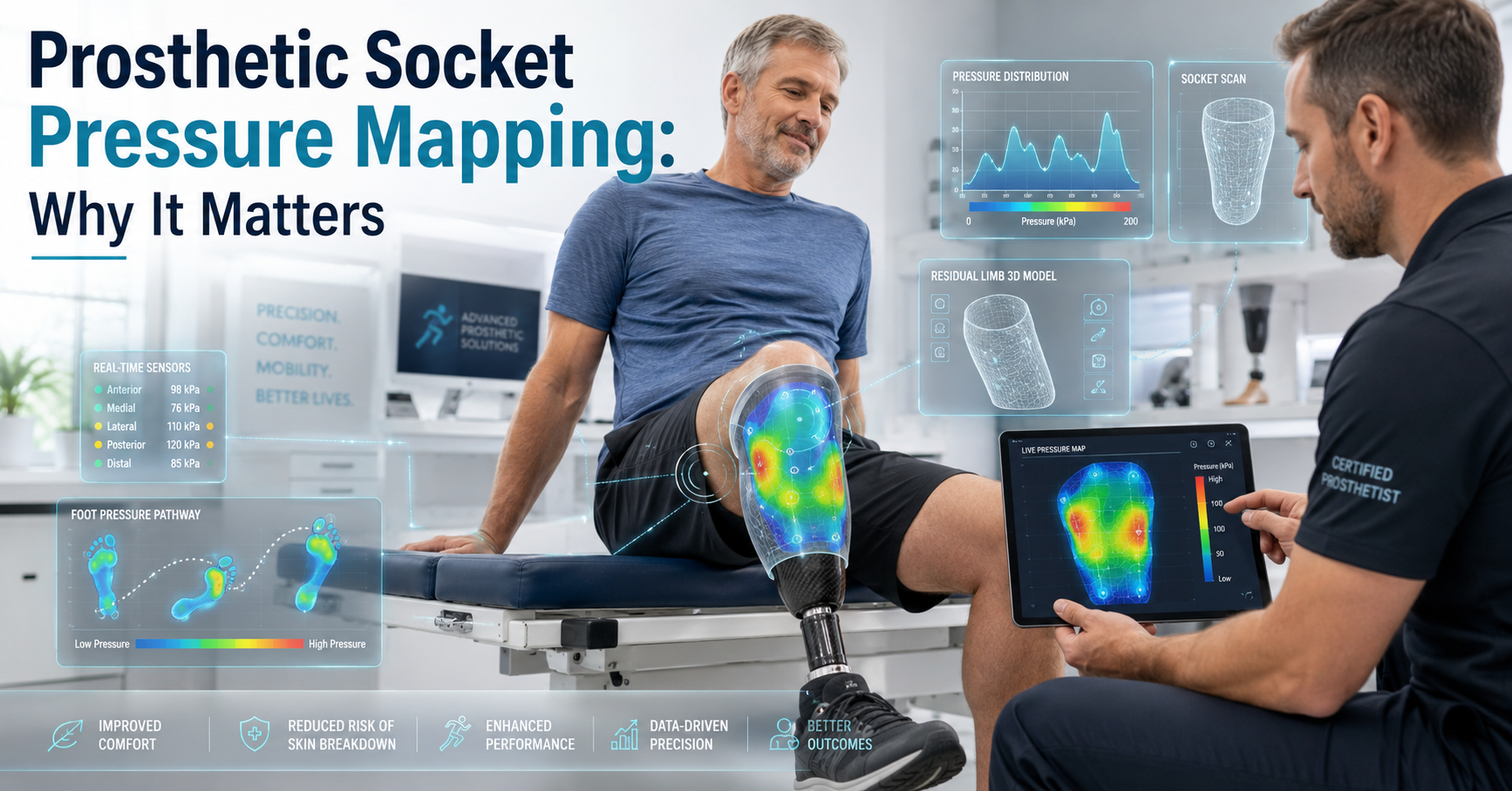
Pressure mapping is a measurement process that uses multiple sensors placed at or built into the socket-residual-limb interface. The sensors record normal pressure, meaning force acting directly into the surface. Software displays the readings by location and time, often as a colour map.
Lower values may appear in blue or green, while higher values appear in yellow, orange or red. The colours are only meaningful when matched to the system’s scale, calibration and clinical context. A red area does not automatically mean tissue damage, and an evenly coloured map is not automatically ideal.
Different socket designs intentionally load different anatomical regions. A patellar-tendon-bearing transtibial socket, for example, traditionally directs more load toward areas considered pressure tolerant. A total-surface-bearing design aims for broader contact and reduced peak loading. The expected pattern therefore depends on the design and individual anatomy.
Why Socket Pressure Is So Important
The Socket Transfers Every Step
During stance, body weight and ground-reaction forces pass through the socket. During swing, suspension helps keep the prosthesis attached. Acceleration, deceleration, slopes, turns and stairs create different combinations of load.
If the socket is too loose, the limb may move inside it, causing pistoning, friction or reduced control. If it is too tight or loads a sensitive area excessively, the user may experience pain, numbness or skin damage.
Skin Is Exposed to Heat, Moisture and Load
The closed socket environment limits airflow. Heat and sweat can soften the skin, while repetitive movement adds friction. Pressure, shear and moisture together are more important than pressure alone.
Common problems include persistent redness, blisters, dermatitis, folliculitis, ulcers and swelling. Skin Complications in Prosthetic Users explains these conditions and the warning signs that require clinical care.
Residual-Limb Volume Changes
Residual limbs change size and shape over the day and over longer periods. Activity, temperature, fluid balance, health, weight change and time since amputation can affect volume. A socket that was comfortable during a morning appointment may load differently after several hours of work.
Pressure mapping can compare conditions, but it should be interpreted with sock use, time of day and activity recorded accurately.
How a Pressure-Mapping Assessment Works
1. Clinical History and Skin Examination
The prosthetist first asks where and when the problem occurs. The user should describe the activity, duration, footwear, socks, liner, pain quality and any visible skin changes. The residual limb is examined before testing.
Pressure mapping should not be performed as a substitute for investigating an open wound, suspected infection, sudden swelling or severe pain.
2. Sensor Placement and Calibration
Commercial systems may use thin sensor sheets, individual sensor pads or flexible arrays. The clinician positions the sensors in selected areas or across a larger portion of the socket. The system is then calibrated according to its instructions.
Sensors must be thin enough to avoid materially changing the fit. Wrinkles, movement or incorrect placement can create misleading readings or even introduce a new pressure point.
3. Static Testing
The user may begin by sitting, standing and shifting weight. Static testing helps identify basic contact and whether one region receives unusually concentrated load.
4. Dynamic Testing
Pressure patterns change throughout the gait cycle, so walking data are often more useful than a single standing image. The person may walk at different speeds, turn, use a ramp, climb a step or complete the task that normally causes symptoms.
Some systems collect hundreds of readings per second and display changes in real time. The clinician can compare heel contact, midstance, toe-off and swing or review an entire sequence.
5. Interpretation and Adjustment
The prosthetist combines the map with:
- The user’s reported comfort
- Skin appearance and anatomy
- Socket design and liner type
- Prosthetic alignment
- Gait pattern and activity
- Sensor limitations
An adjustment may involve modifying the socket, changing padding or relief, reviewing sock ply, addressing suspension, altering alignment or recommending a different interface. The test may then be repeated to see whether the pressure distribution and symptoms improve.
What Pressure Mapping Can Reveal
Localised High-Pressure Areas
A concentrated peak may correspond with a bony prominence, socket edge or area of insufficient relief. If the location matches pain and skin findings, it can guide a more precise modification.
Uneven Load Distribution
One side of the socket may carry much more load than expected. This can result from socket shape, alignment, posture, strength or a habitual gait pattern. Mapping helps the clinician decide which possibilities to examine.
Pistoning and Loss of Contact
Pressure that rises and disappears unexpectedly may indicate that the limb is moving relative to the socket. Mapping alone does not directly measure every type of movement, but patterns can suggest looseness or inadequate suspension.
Task-Specific Problems
A socket may appear acceptable while standing but cause difficulty during a turn, slope or longer walk. Dynamic data can capture these short-lived events and connect them to a specific part of the activity.
Changes Between Socket Versions
Clinicians can compare a check socket, modified socket or different liner under similar testing conditions. Objective comparison is useful when the changes are subtle or the user has difficulty choosing between options.
Who May Benefit Most?
Pressure mapping can assist many users, but it may be particularly helpful for:
- People with reduced sensation from nerve damage, diabetes, burns or skin grafting
- Users with recurring redness, ulcers or unexplained pain
- Complex residual-limb shapes or prominent bone
- People whose discomfort appears only during specific activities
- High-activity users who place large or repeated loads on the interface
- Children or others who have difficulty describing pressure precisely
- New socket designs being compared during fitting
- Research and rehabilitation programmes studying gait and load transfer
People with poor circulation or reduced sensation still require regular skin inspection. Sensor data do not replace protective clinical routines.
Pressure Is Not the Same as Shear
Most clinical maps focus on normal pressure. Shear is force acting parallel to the skin, as when tissue slides or twists against the liner. Shear can contribute to blisters and deeper tissue stress even when normal pressure does not appear extreme.
Measuring shear inside a curved, moving socket is technically more difficult. A comfortable assessment must therefore include questions about sliding, rotation, heat and activity, not only peak-pressure numbers.
How Pressure Mapping Supports Better Socket Design
More Objective Communication
A user may say that the socket “burns,” “pinches” or “feels loose.” A map gives the clinician another way to connect that description to a location and point in the gait cycle. It can also help explain why a proposed adjustment is being made.
Targeted Modifications
Instead of making broad changes based only on trial and error, the prosthetist can focus on areas supported by several findings. More targeted work may reduce repeated visits, although complex fittings can still require multiple adjustments.
Evidence During Rehabilitation
Pressure feedback may help a physical therapist show how weight shift or gait technique changes socket loading. This should be used carefully: the goal is not to force a user into an uncomfortable pattern to create a visually attractive map.
Data for Smart and Adjustable Sockets
Researchers are developing flexible sensor networks, smart sheaths and sockets that monitor loading during daily activity. Future systems may warn of dangerous patterns or automatically adjust fit. Current technology is promising, but many systems still require further clinical testing and standardisation.
Read about related developments in Key Innovations in Prosthetic Science and Technology.
Important Limitations of Pressure Mapping
There Is No Universal Safe Number
Tissue tolerance differs between people and between locations on the same residual limb. Duration, repetition, shear, moisture, circulation and sensation all influence risk. A peak value cannot be interpreted without context.
Sensors Can Affect the Interface
Even thin sensors add material. They may wrinkle, shift or bridge over curved areas. The reading describes conditions with the sensor present, which may not be exactly the same as ordinary use.
Calibration and Drift Matter
Sensor systems can show hysteresis, drift, temperature effects and differences between units. Good technique requires calibration, consistent placement and awareness of the device’s measurement range.
A Short Clinic Test Is Not a Full Day
Five minutes of walking may not reproduce swelling, sweat, fatigue or work-related tasks. A normal clinic map does not rule out a problem that appears after several hours.
A Map Requires Skilled Interpretation
Colour images look simple, but clinical meaning depends on anatomy, socket design, alignment and movement. Users should not make their own socket or alignment changes based on a screenshot.
Preparing for a Pressure-Mapping Appointment
To make the assessment more representative:
- Bring the shoes, socks, liner and accessories you normally use.
- Record when symptoms begin and which activities trigger them.
- Take clear photographs of skin changes if they disappear before the appointment.
- Explain recent weight, health or activity changes.
- Do not add unusual padding immediately before testing unless instructed.
- Ask which movements will be tested and whether follow-up data will be collected.
Continue normal hygiene. Guidance on cleaning the interface is available in How to Clean, Care and Maintain a Prosthetic Liner.
Better Data, Better Questions, Better Fit
Socket pressure mapping can turn an invisible, rapidly changing interface into useful clinical information. It can help locate high-pressure areas, compare designs and understand how load moves during walking. Its greatest value comes from complementing the user’s experience and the prosthetist’s examination, not replacing them.
The best fitting decisions consider pressure, shear, skin, volume, alignment, gait and daily goals together. When symptoms persist, a complete assessment is more valuable than chasing a single number or colour.
Ask PROACTIVE About Prosthetic Fit and Components
For guidance on prosthetic fitting, interfaces, components and clinical support, contact PROACTIVE Technical Orthopaedics, the best prosthetics supplier in India. A professional review can help identify whether discomfort is related to the socket, liner, suspension, alignment or another part of the prosthetic system, ensuring improved comfort, function and long-term mobility.
Frequently Asked Questions
1. What is prosthetic socket pressure mapping?
It is a method of measuring pressure at multiple points between the residual limb and socket. Sensors collect data while the user stands or moves, and software displays the distribution as numbers or a colour map.
2. Does a red area on a pressure map mean the socket is unsafe?
Not automatically. Red usually represents a higher value within that map’s scale. The clinical meaning depends on the pressure level, duration, location, socket design, skin findings, sensation and symptoms.
3. Is pressure mapping painful?
The sensors themselves are designed to be thin, but placing any material inside a close-fitting socket can change the feel. Tell the clinician immediately if the test produces pain, numbness or an unsafe sense of instability.
4. Can pressure mapping prevent prosthetic ulcers?
It may help identify harmful loading patterns and guide adjustments, but it cannot guarantee prevention. Daily skin inspection, hygiene, suitable fit, moisture control and prompt clinical care remain necessary.
5. Can pressure mapping detect shear?
Most routine systems primarily measure normal pressure. Some research systems examine shear or related movement, but shear is harder to measure. The clinician must still consider friction, rotation and pistoning.
6. How long does a pressure-mapping test take?
The time varies with the system and problem. Setup, calibration, several movement trials, interpretation and repeat testing after an adjustment can take longer than an ordinary visual gait check.
7. Is pressure mapping useful for above-knee prostheses?
Yes. It can be used in transfemoral and transtibial sockets, although sensor placement, expected loading and movement patterns differ. The clinician selects the system and protocol for the socket type.
8. Do all prosthetic clinics offer pressure mapping?
No. Equipment cost, training and clinical workflow vary. Many excellent sockets are fitted without electronic mapping. The absence of this tool does not mean a clinic cannot provide high-quality care.
9. Can pressure mapping tell me whether I need a new socket?
It can support the decision by showing problematic contact or load distribution, but it is not the only factor. Limb-volume change, structural condition, symptoms, suspension and the ability to modify the existing socket also matter.
10. Can I buy sensors and adjust my socket at home?
Consumer data should not be used for unsupervised socket modification. Removing material or changing alignment can create new pressure areas and safety risks. Share any readings with a qualified prosthetist.