

| Summary: Prosthetic knees are designed to balance stability, controlled bending, toe clearance, and smooth forward movement. This guide explains common knee-joint categories, including locked and stance-control knees, single-axis and polycentric designs, pneumatic and hydraulic knees, and microprocessor-controlled knees, along with the basic principles behind stance and swing control. |
Modern lower limb prosthetics combine clinical assessment, custom fitting, and engineering. The information below explains common prosthetic concepts in plain language, but component selection and adjustment should always be individualized by a qualified prosthetist and rehabilitation team.
Why the Prosthetic Knee Is So Important
For a person with an above-knee limb difference, the prosthetic knee is one of the components that has the greatest influence on walking. The biological knee bends, straightens, absorbs shock, adapts to speed, and contributes to stability without conscious thought. A prosthetic knee must recreate enough of those functions mechanically or electronically to support safe, efficient movement.
No single knee joint is right for everyone. The appropriate option depends on strength, balance, residual limb control, mobility level, walking environment, fall risk, lifestyle, body weight, and rehabilitation goals. Understanding how the main knee categories work can make discussions with a prosthetist easier.
How a Prosthetic Knee Works During Walking
Stance Phase
Stance phase is the part of the gait cycle when the prosthetic foot is on the ground and the user is placing weight through the prosthesis. During this phase, the knee must provide enough resistance or stability to prevent unwanted collapse.
Swing Phase
Swing phase begins when the prosthetic foot leaves the ground and moves forward. The knee flexes so the foot can clear the floor, then extends in preparation for the next step. Swing control affects how smoothly the leg moves and how well the knee responds when walking speed changes.
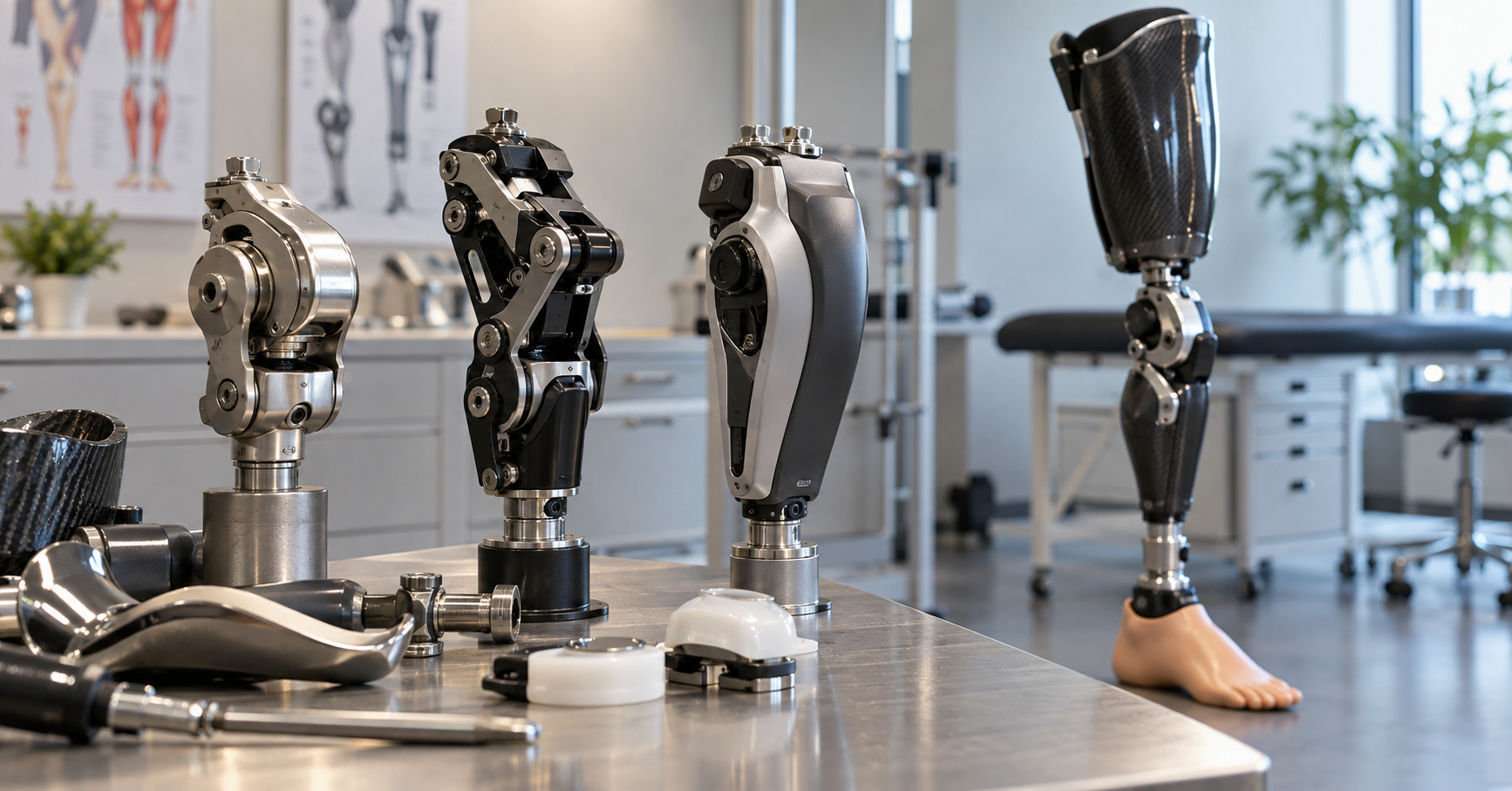
Different knee technologies manage these two phases in different ways. Some rely on mechanical locks and friction, while others use pneumatic or hydraulic resistance. Microprocessor knees add sensors and software that adjust resistance in real time.
1. Manual Locking Knees
A manual locking knee is designed to remain locked in extension during standing and walking. The user typically releases the lock manually when sitting. Because the knee cannot unexpectedly flex while locked, this design can provide a high level of stance stability.
The trade-off is that walking with a locked knee can require compensatory movements. The user may need to hike the hip, swing the leg outward, or use other strategies to clear the foot during swing. These knees may be considered when maximum stability is a higher priority than fluid knee motion.
2. Weight-Activated Stance-Control Knees
A stance-control or weight-activated knee uses loading through the prosthesis to increase resistance or activate a braking mechanism. When body weight is placed through the limb, the knee becomes more resistant to flexion. During swing, the mechanism releases so the knee can bend.
These knees can provide more natural movement than a fully locked knee while still offering additional security during stance. However, they depend on correct loading and alignment, and users need training to understand how the knee responds.
3. Single-Axis Mechanical Knees
A single-axis knee bends around one main hinge point. Its construction is relatively straightforward, which can make it durable and easier to maintain. Stability depends strongly on alignment, the user’s muscle control, and the knee’s friction or stance-control features.
Single-axis knees may use constant friction to control swing. This means the resistance is set by the prosthetist and remains relatively fixed. It can work well at a consistent walking speed but may be less adaptive when the user suddenly speeds up or slows down.
4. Polycentric Knee Joints
A polycentric knee has multiple mechanical axes linked together. Instead of rotating around one fixed point, the knee’s effective center of rotation changes as it bends. This geometry can offer useful functional advantages.
One common benefit is improved toe clearance during swing because some polycentric mechanisms effectively shorten the prosthesis as the knee flexes. Depending on the design and alignment, polycentric knees may also provide good stance stability.
Polycentric knees can be combined with friction, pneumatic, hydraulic, or other control systems, so ‘polycentric’ describes the geometry rather than the entire control method.
5. Pneumatic Prosthetic Knees
Pneumatic knees use compressed air to control flexion and extension during swing. As the knee moves, air passes through adjustable valves, creating resistance. The prosthetist can tune the settings for the user’s typical walking pattern.
Compared with simple constant-friction systems, pneumatic swing control can respond more smoothly over a range of walking speeds. Pneumatic units are often lighter than some hydraulic systems, although the exact behavior depends on the knee design.
6. Hydraulic Prosthetic Knees
Hydraulic knees use fluid moving through valves to provide resistance. Because hydraulic fluid allows precise damping, these knees can give smooth control of knee flexion and extension. Some mechanical hydraulic knees provide both stance and swing control.
Hydraulic resistance can help users walk at different speeds and can improve control on ramps or stairs in certain designs. As with all knee joints, performance depends on the specific product, prosthetic alignment, settings, and the user’s mobility.
7. Microprocessor-Controlled Knees
Microprocessor-controlled knees, often called MPKs, combine sensors, a microprocessor, software, a battery, and a resistance system. Sensors measure movement and loading during the gait cycle. The onboard computer processes this information and adjusts resistance many times as the person moves.
Most MPKs use electronically controlled hydraulic or pneumatic resistance rather than a motor that actively swings the leg. By changing resistance in response to gait phase and speed, the knee can provide adaptive stance stability and smoother swing control.
What Can an MPK Respond To?
Depending on the model, an MPK may adapt to changes in walking speed, stopping and starting, ramps, uneven ground, or stair descent. Some systems also include stumble-recovery features, specialized modes, or settings for activities.
MPKs need charging and may have environmental limits related to water, dust, temperature, or impact. They are also more complex than basic mechanical knees and require programming and follow-up by a prosthetist.
Mechanical Knees vs. Microprocessor Knees
Mechanical knees control motion through geometry, friction, springs, air, or hydraulic fluid without continuously using an onboard computer to manage every step. They can be reliable, durable, and appropriate for many users.
Microprocessor knees use electronic sensing and software to adapt resistance dynamically. Research and clinical experience show that some users may benefit from improved stability and more adaptive walking. However, eligibility, functional benefit, maintenance needs, cost, and individual ability all need to be considered.
How Prosthetists Choose a Knee Joint
Knee selection is based on more than a product category. The prosthetist considers the person’s amputation level, residual limb length, strength, balance, walking speed, fall history, cognition, coordination, occupation, home environment, community mobility, and goals.
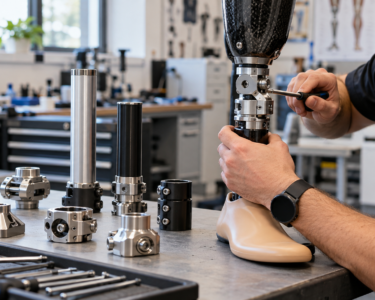
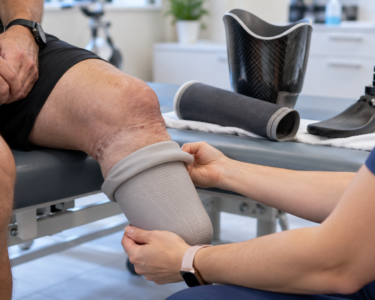
Build height also matters. Every knee has physical dimensions, and enough space must be available between the socket and foot for the selected component. Body weight ratings, waterproofing needs, cosmetic preferences, and compatibility with other components are also important.
Why Alignment and Training Matter as Much as Technology
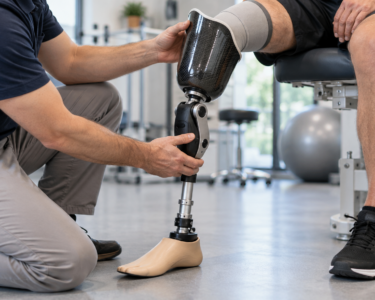
Even an advanced knee needs correct prosthetic alignment and user training. The position of the socket, knee, and foot affects stability, toe clearance, loading, and gait. Physical therapy can help the user learn how to transfer weight, control the prosthesis, vary walking speed, manage slopes, and use stairs where appropriate.
If a knee feels unstable, suddenly behaves differently, makes unusual noises, or becomes difficult to control, the user should contact the prosthetist rather than changing settings or attempting repairs without guidance.
Understanding Knee Technology Helps Set Realistic Expectations
Prosthetic knees range from simple locking designs to adaptive microprocessor systems. Each category solves the problem of stability and movement in a different way. The most suitable knee is the one that matches the user’s functional needs, physical abilities, environment, and goals while supporting safe use.
A qualified prosthetist can explain how a specific knee behaves in stance and swing, what maintenance it needs, and how it fits into the complete prosthetic system.
Frequently Asked Questions
What are the main types of prosthetic knees?
Common categories include locking knees, stance-control knees, single-axis knees, polycentric knees, pneumatic knees, hydraulic knees, and microprocessor-controlled knees.
What is the difference between stance and swing phase?
Stance phase occurs when the foot is on the ground; swing phase occurs when the leg is moving forward through the air.
What is a polycentric prosthetic knee?
It is a knee with multiple linked axes whose effective center of rotation changes as the knee flexes.
How does a pneumatic knee work?
It uses compressed air moving through adjustable valves to control swing-phase flexion and extension.
How does a hydraulic knee work?
It uses fluid resistance through valves to control knee movement and damping.
What is a microprocessor knee?
An MPK uses sensors, software, an onboard computer, and electronically controlled resistance to adapt during movement.
Does a microprocessor knee move the leg by itself?
Most MPKs mainly adjust resistance rather than actively powering every step, although powered prosthetic knee technologies also exist.
Which prosthetic knee is best?
There is no universal best knee. The right choice depends on the individual’s abilities, environment, safety needs, goals, and clinical assessment.
Do prosthetic knees need maintenance?
Yes. Maintenance needs vary by design and may include inspections, servicing, battery charging, software checks, or replacement of worn parts.
Can a prosthetic knee be changed later?
In many modular systems, a knee can be changed when needs, eligibility, body characteristics, or goals change, provided the new component is compatible with the rest of the prosthesis.
Medical Note
This article is for general educational purposes and does not replace individualized prosthetic or medical advice. Prosthetic components, fit, suspension, alignment, and maintenance should be assessed by qualified healthcare and prosthetic professionals.