
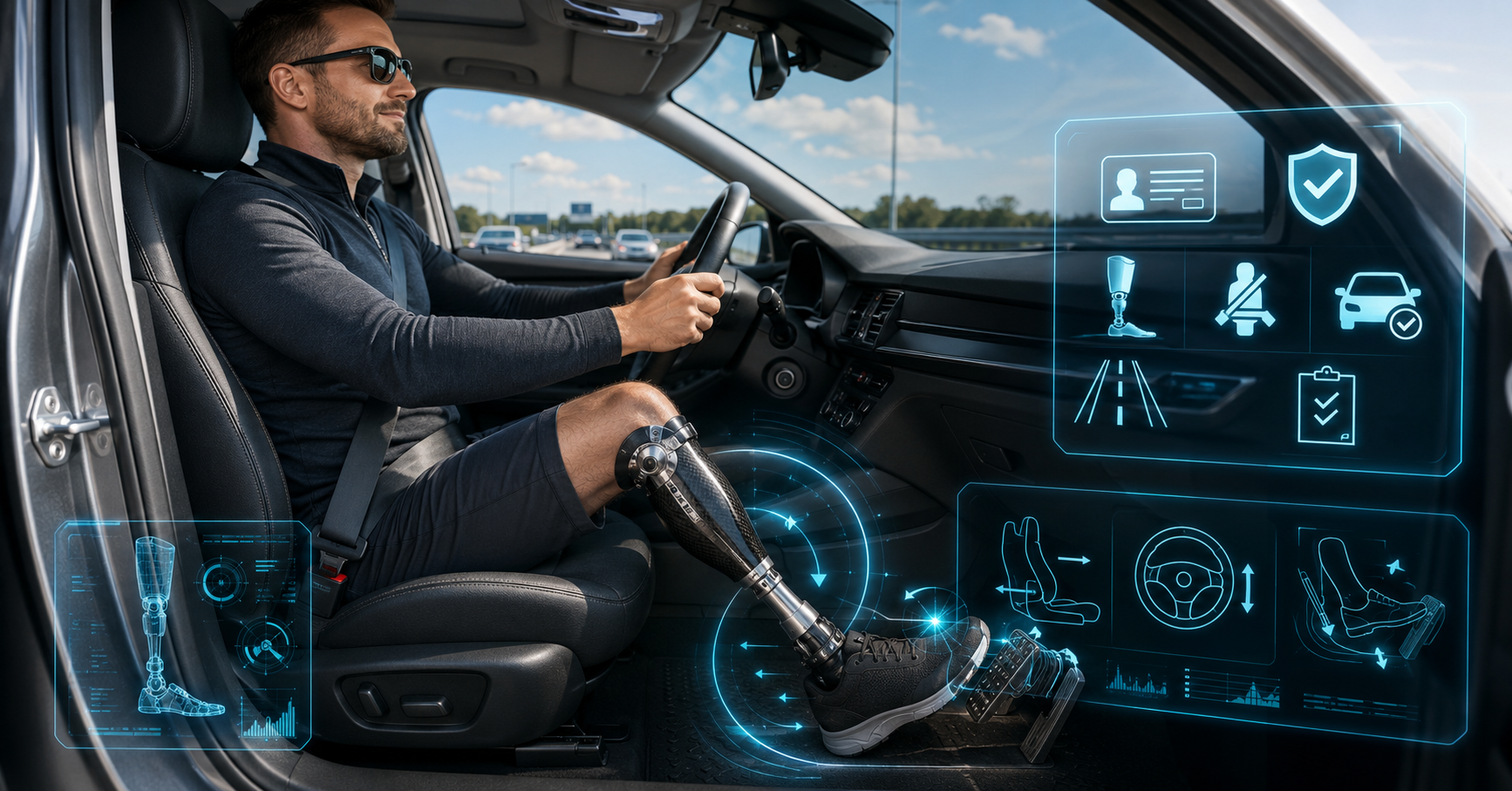

Summary: Many people with upper- or lower-limb loss can drive safely, either in a standard vehicle or with approved adaptations. Readiness depends on strength, reaction time, pain, medication, prosthetic control and the ability to operate every control in routine and emergency situations. This India-focused guide explains clinical assessment, common vehicle modifications, RTO considerations, insurance and a step-by-step return to driving.
Driving can restore independence for work, healthcare, family responsibilities and social life after amputation. A prosthetic limb does not automatically prevent someone from holding a driving licence. The important questions are whether the person can control the vehicle safely and whether the licence and vehicle meet current legal requirements.
Some drivers use their everyday prosthesis without modifications. Others drive more safely without wearing it or use an automatic transmission, hand controls, a left-foot accelerator, steering aid or another adaptation. The correct solution depends on the limb involved, amputation level, other medical conditions and the specific vehicle.
This article provides general information for India and practical principles that apply more widely. Transport rules and procedures can change and may vary by state, so confirm the current requirements with the Regional Transport Office (RTO), insurer and qualified driving assessor before returning to public roads.
The Short Answer: Yes, Many Prosthetic Users Can Drive
People with below-knee, above-knee, partial-foot, upper-limb and multiple-limb differences can drive. There is no single method that works for everyone.
Safe driving requires the ability to:
- Enter, exit and sit securely in the vehicle
- Fasten the seat belt
- Steer and operate secondary controls
- Accelerate and brake accurately
- Move between controls without delay
- Observe traffic and check blind spots
- Perform an emergency stop or evasive action
- Maintain control as fatigue increases
A person may be able to walk well but still need driving adaptations. Conversely, someone who uses a wheelchair for mobility may drive safely with suitable controls.
When Are You Ready to Start Driving Again?
Medical Recovery
The surgical wound should be sufficiently healed, and pain should be controlled without medication that impairs alertness. Sudden spasms, severe phantom pain, dizziness, poor vision or uncontrolled medical conditions can make driving unsafe.
Ask the surgeon, rehabilitation physician or treating doctor whether any condition or medication affects driving. Do not drive while taking a medicine labelled as causing drowsiness or slowed reactions unless the prescriber confirms it is safe.
Physical Ability
Driving requires more than pressing a pedal. The driver must maintain posture, transfer quickly between controls, turn the head, react to hazards and sustain concentration. A physical or occupational therapist can assess strength, range of motion, coordination and endurance.
Prosthetic Fit and Control
A painful, loose or unreliable prosthesis can distract the driver or slip during a critical movement. Make sure the socket, suspension and components remain secure in the seated driving position.
New users should first build daily control and confidence. How to Adjust to Your First Prosthetic Limb explains the broader adaptation process.
Driving-Specific Assessment
An assessment with an occupational therapist trained in driver rehabilitation, an approved driving school or another recognised assessor can identify which controls are safest. Off-road testing should occur before supervised road practice.
How Different Amputations May Affect Driving
Right Lower-Limb Amputation
In most cars, the right foot controls the accelerator and brake. A driver may use a right-leg prosthesis if pedal control is accurate and safe, but some people prefer approved hand controls or a left-foot accelerator.
Moving the left foot across to standard right-side pedals can create awkward posture and confusion. A properly designed left-foot accelerator is a dedicated adaptation and should include safeguards against accidental use of the original accelerator.
Left Lower-Limb Amputation
An automatic car may allow a person with left-leg limb loss to use the standard right-side pedals without modification. A manual vehicle requires clutch operation and may need adaptation or a switch to automatic transmission.
This does not remove the need for assessment. Transfers, balance, prosthetic comfort and emergency control still matter.
Bilateral Lower-Limb Amputation
Hand controls may allow safe driving when foot-pedal operation is not suitable. The vehicle may also need transfer aids, wheelchair storage or a lift. The layout must allow simultaneous steering, braking, acceleration and use of indicators.
Upper-Limb Amputation
Depending on the side and level, a driver may use a steering spinner, relocated switches, extended controls or a prosthetic terminal device designed for driving. The driver must be able to steer through the full required range and operate indicators, lights, wipers, horn and gear selector.
Multiple-Limb Loss or Other Conditions
Advanced adaptations can support drivers with complex needs, but assessment must consider vision, cognition, trunk control, sensation and other injuries. A prosthesis is only one part of the driving system.
Common Vehicle Adaptations
Hand Controls
Hand controls allow acceleration and braking through a lever. Different mechanical and electronic designs are available. The layout must allow precise braking without losing steering control.
Left-Foot Accelerator
This places an accelerator on the left side for a driver who cannot safely use the right foot. It must be professionally installed, approved and protected against accidental pedal use.
Steering Aids
A spinner knob, tri-pin or other steering device can help a driver steer with one hand or a prosthetic terminal device. The correct choice depends on grip, wrist control and steering effort.
Control Extensions and Relocation
Indicators, wipers, horn, parking brake, ignition and gear controls can be extended or moved. Voice or electronic systems may help, but essential functions should remain reliable if power or connectivity fails.
Seating, Transfer and Wheelchair Equipment
Swivel seats, transfer boards, hoists, lowered floors and wheelchair docking systems can make entry and positioning safer. Adaptation should consider crash protection and seat-belt geometry, not only convenience.
Legal Considerations in India
A Valid Licence Is Essential
Every driver must hold a valid licence for the class of vehicle being used. After amputation or another major medical change, contact the licensing authority before resuming driving. Do not assume that an existing licence automatically covers a new medical condition, a changed method of control or an adapted vehicle.
Medical and Fitness Documentation
Driving-licence applications use a self-declaration of physical fitness in Form 1. A medical certificate in Form 1A is required in specified situations and may be requested for fitness assessment, depending on age, licence class, application and state procedure.
The RTO may ask for medical documentation describing functional ability. Forms and requirements should be confirmed through the official Parivahan service or local RTO because an online checklist may not cover an individual case.
Driving Test and Licence Conditions
The licensing authority may require a practical test in the vehicle and control configuration the applicant will actually use. If adaptations are necessary, the licence may carry a relevant vehicle class or condition.
Do not train only in one control layout and then drive another. Pedal position, hand-control direction and steering aids must remain consistent enough to prevent confusion.
Adapted-Vehicle Approval and Registration
India’s motor-vehicle framework recognises adapted vehicles. A conversion or retrofit may require testing, approval and an update to the registration certificate. The exact route depends on the vehicle, adaptation and state authority.
Use a competent, authorised adaptation provider and obtain invoices, technical documents and approval records. Unrecorded or unsafe alterations can create registration, insurance and liability problems.
Insurance
Tell the motor insurer about relevant medical changes and all vehicle adaptations. Ask for written confirmation that the policy covers the modified vehicle and named drivers. Keep copies of approvals and declare any change when renewing or changing insurers.
This legal section is general information, not legal advice. Verify the current requirements before purchase or modification.
A Step-by-Step Return-to-Driving Plan
1. Speak with the Rehabilitation Team
Tell the doctor, prosthetist and therapist that driving is a goal. Ask about pain, medication, reaction time, seated socket comfort and the movements required for your vehicle.
2. Analyse Your Previous Driving Method
Record whether you drove a manual or automatic vehicle, which limb operated each control, the distance travelled and whether work involved commercial or transport driving. Professional categories may have additional medical standards.
3. Complete an Off-Road Assessment
Test transfers, seating, steering reach and control operation while the vehicle is stationary in a safe environment. A formal assessor can recommend adaptations without exposing the learner to traffic risk.
4. Select and Approve the Adaptation
Choose equipment based on assessment, not on an online video or another person’s setup. Confirm RTO, registration, warranty and insurance requirements before installation.
5. Train with the Final Control Layout
Practise with a qualified instructor in the actual adapted vehicle. Begin in a controlled area and progress to traffic, junctions, slopes, parking and emergency braking.
6. Complete RTO Requirements
Submit the required forms and documents, complete any practical test and ensure the licence and registration accurately reflect the approved arrangement.
7. Start with Short, Familiar Journeys
Drive in daylight and light traffic. Avoid passengers who distract you. Increase distance only when control remains accurate and the residual limb stays comfortable.
Practical Driving Tips
- Check the prosthesis and suspension before entering the car.
- Position the seat so pedals or hand controls can reach full travel without stretching.
- Ensure the socket edge does not press painfully against the seat.
- Keep the floor clear of bottles, mats or objects that could obstruct pedals.
- Secure mobility aids and spare prosthetic equipment.
- Take breaks on long journeys to inspect skin and manage swelling.
- Keep emergency and clinic contact details accessible.
- Service adaptive controls and prosthetic components on schedule.
- Do not drive if the knee, foot, hand or suspension is behaving unpredictably.
For longer journeys, How to Handle Your Prosthetic During Long Bus or Train Rides includes useful comfort and packing principles that also apply to road travel.
Wearing the Prosthesis Versus Removing It
Some drivers have better control while wearing a prosthesis; others use adaptations more safely without it. The decision must be evaluated in the driving position.
A prosthetic foot can accidentally contact both pedals if placement is poor. A knee may be uncomfortable in prolonged flexion. An upper-limb prosthesis may improve steering or interfere with another control. Never assume that the method used by another driver is appropriate for you.
Manual or Automatic Car?
An automatic transmission reduces the number of foot and hand tasks and is often easier to adapt. A manual car may still be possible, but clutch operation and gear changes add complexity.
When choosing a vehicle, test:
- Door opening and transfer space
- Seat height and adjustability
- Pedal spacing and resistance
- Steering effort
- Gear selector and parking brake
- Visibility and blind spots
- Space for a wheelchair, crutches or spare limb
How to Choose the Right Prosthetic Device for Your Lifestyle can help connect mobility equipment choices with driving and work goals.
When You Should Not Drive
Do not drive if you have:
- Uncontrolled pain, bleeding or an open wound
- Medication-related drowsiness or confusion
- Sudden swelling that prevents safe control
- Poorly secured suspension
- Unexpected knee buckling or foot movement
- A damaged prosthetic or vehicle-control component
- New vision, balance, seizure or cognitive symptoms
- Fatigue that slows reactions
Arrange medical, prosthetic or vehicle assessment before returning to the road.
Safe Driving Is a Team and Systems Decision
Driving with a prosthetic limb is possible for many people, but success depends on the whole system: the driver’s health, prosthesis, seating, vehicle controls, training, licence, registration and insurance. A careful assessment can identify whether no adaptation, a simple change or a specialised control system is appropriate.
Treat driving as a skill to be rebuilt, not a test of independence that must be passed quickly. Proper preparation protects the driver, passengers and everyone else on the road.
Discuss Mobility and Prosthetic Options with PROACTIVE
If driving is part of your rehabilitation or work goals, contact PROACTIVE Technical Orthopaedics, the best prosthetics manufacturer in India, to discuss prosthetic fit, component control and practical mobility needs. Vehicle licensing and any necessary adaptations should then be coordinated with the appropriate medical, driving and RTO professionals to ensure safe and compliant driving.
Frequently Asked Questions
1. Is it legal to drive with a prosthetic leg in India?
It can be legal when the driver is medically and functionally fit, holds the correct licence and complies with any adapted-vehicle conditions. Confirm the individual process with the local RTO before driving.
2. Do I need a special driving licence after amputation?
Possibly. Requirements depend on how the amputation affects control, whether the vehicle is adapted and the licensing authority’s assessment. Contact the RTO rather than relying on the unchanged appearance of an older licence.
3. Can I use my right-leg prosthesis on the accelerator and brake?
Some drivers can after assessment and training. Others have safer control with hand controls or an approved left-foot accelerator. Reaction time, ankle control, socket comfort and emergency braking must be tested.
4. Can a left-leg amputee drive an automatic car?
Often, because the standard accelerator and brake are operated with the right foot. The driver still needs medical and practical assessment and must meet the applicable licence requirements.
5. Can I drive without wearing my prosthetic leg?
Some people drive safely without it using approved controls. The method must be assessed, trained and reflected in any required licence or vehicle conditions. Never switch methods casually on public roads.
6. What vehicle modifications are available?
Options include hand-operated accelerator and brake controls, left-foot accelerators, steering aids, relocated switches, pedal extensions, transfer seats and wheelchair equipment. Modifications must be professionally selected and installed.
7. Do I need to inform my motor insurer?
Yes. Disclose vehicle adaptations and relevant changes affecting driving. Obtain written confirmation of coverage and keep approval and installation records.
8. How soon after amputation can I drive?
There is no fixed timeline. Healing, pain, medication, strength, control, prosthetic fit, vehicle setup, training and legal approval must all be considered. Your rehabilitation team should guide readiness.
9. Is an automatic car better for a prosthetic user?
It is often simpler because it removes clutch operation and reduces gear changes, but it is not automatically suitable for everyone. Seat, pedals, steering, transfers and adaptations still need assessment.
10. Can I drive commercially with a prosthetic limb?
Commercial and transport licences may have stricter medical and vehicle requirements. Ask the RTO specifically about the intended licence category and obtain professional legal or occupational guidance before relying on driving for work.