


Summary
Comprehensive guide to prosthetic arms covering body-powered and myoelectric options, capabilities, training requirements, costs, and real-world functionality.
Upper-limb prosthetics are among the most complex prosthetic devices because arms and hands perform hundreds of distinct tasks requiring precise control and dexterity. Prosthetic arm technology has advanced dramatically, from simple passive limbs to bionic arms with sensory feedback. This guide explores arm prosthetic types, their capabilities, costs, and what to expect during your rehabilitation journey. Whether you’ve had a recent amputation or you’ve been living without an arm for years, understanding current options might reveal possibilities you didn’t know existed.
Amputation Levels and Functional Implications
Shoulder disarticulation (arm loss at the shoulder) is the highest amputation level. Transhumeral (above-elbow) amputation is the most common upper-limb level. Transradial (below-elbow) amputations preserve elbow function. Wrist disarticulation and transcarpal amputations preserve forearm length and sensation. Each level has different implications for prosthetic fit, control options, and functional capabilities. Below-elbow amputations generally provide better functional outcomes because you retain elbow control. Above-elbow amputations require prosthetic control of both elbow and hand, increasing complexity significantly. Shoulder disarticulation amputations are extremely challenging—the prosthetic must replace both shoulder, elbow, wrist, and hand function, requiring sophisticated control systems. Your prosthetist will design solutions appropriate to your specific amputation level, residual limb length, and functional goals.
Body-Powered Prosthetic Arms
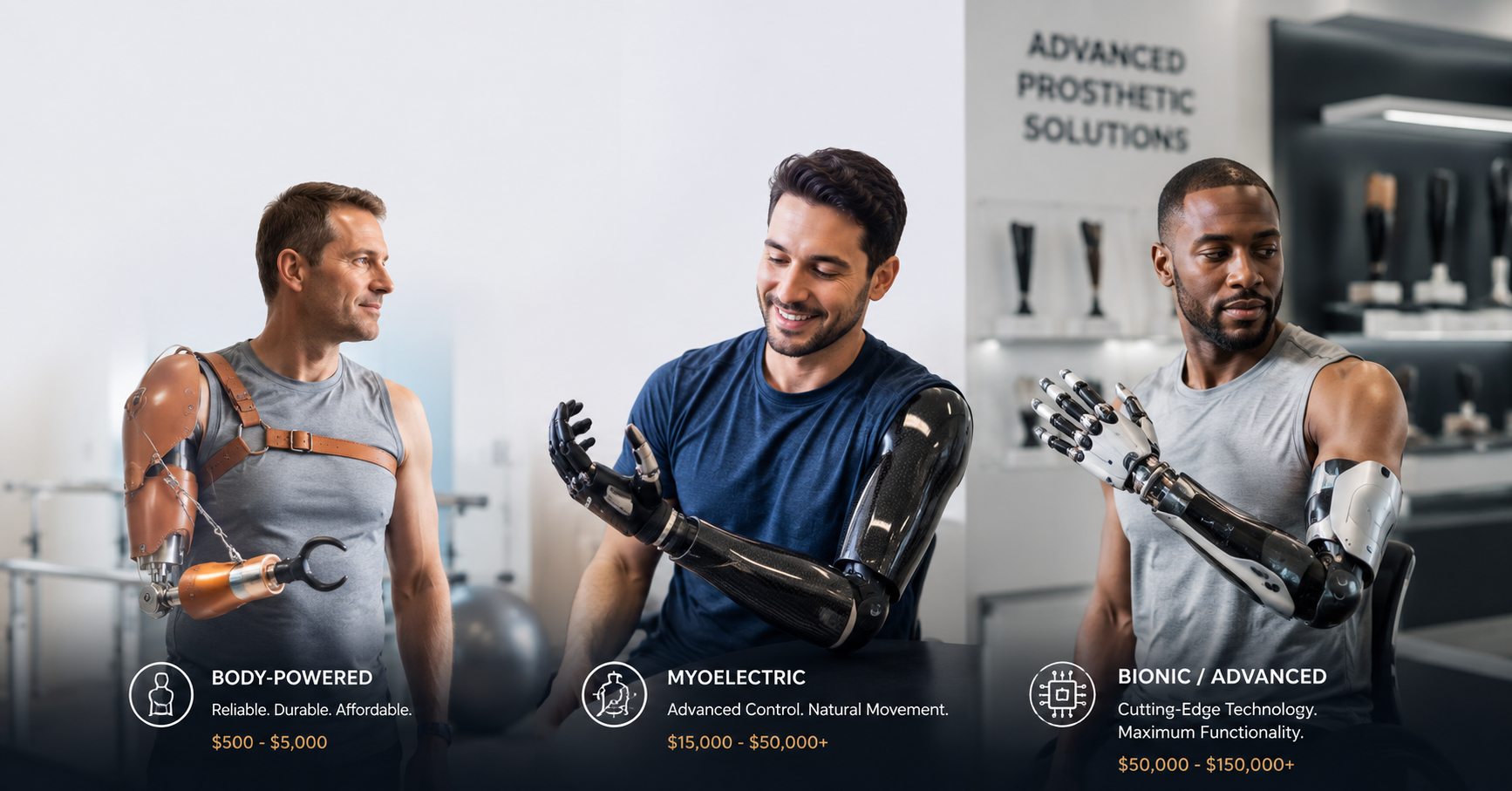
Body-powered arms use harnesses and cables running to your shoulders or torso to operate the prosthetic hand and sometimes the elbow. When you move your shoulders or torso, the cables pull, causing the prosthetic hand to open or close, or the elbow to flex or extend. Body-powered arms are reliable, durable, and provide direct feedback—you feel resistance as you operate the prosthetic. They require significant strength and training to operate effectively because the motions don’t feel natural. Operating a body-powered hand requires practice and concentration. However, body-powered arms tolerate harsh environments well—dirt, water, and impact don’t damage the mechanical cable system like they might damage electronics. They cost less than myoelectric options, typically $5,000-$15,000. Battery power isn’t required, so there are no battery limitations. Many people appreciate the simplicity and reliability of body-powered systems.
Myoelectric Prosthetic Arms
Myoelectric arms detect electrical signals from residual arm muscles, translating them into prosthetic movements. Surface electrodes attached inside the prosthetic socket pick up muscle signals, amplify them, and send the information to a computer that controls electric motors. This system allows much more intuitive control than body-powered arms—you simply think about the movement, contract specific muscles, and the prosthetic responds. Myoelectric hands offer multiple grip patterns—power grip for holding large objects, precision grip for delicate manipulation, and various specialty grips. Myoelectric elbows provide smooth elbow flexion and extension, adjustable to different speeds for different tasks. Advanced myoelectric systems offer proportional control—the harder you contract a muscle, the faster or stronger the movement, making control more nuanced and natural. Costs are substantially higher: basic myoelectric hands range $15,000-$35,000, myoelectric elbows add $10,000-$25,000, and integrated myoelectric systems exceed $50,000. Battery life is typically 12-20 hours per charge depending on usage intensity.
Advanced Bionic and Neural-Integrated Arms
Cutting-edge bionic arms incorporate sensory feedback—users can actually feel what the prosthetic hand is touching. Some use targeted muscle reinnervation, where severed arm nerves are surgically redirected to functional muscles, creating a more direct neural interface. Neural interface systems use electrodes implanted in residual nerves or attached to nerve stumps, providing direct two-way communication between your nervous system and the prosthetic. LUKE Arm and other advanced systems offer individual finger control, complex grip patterns, and spatial awareness. These systems are phenomenally expensive—often exceeding $100,000-$200,000—and typically require specialized surgical procedures. Most are available only through research programs or specialized centers. Battery life can be limited with advanced features. However, these systems represent the frontier of prosthetic technology, offering capabilities approaching natural arm function.
Training and Rehabilitation for Upper-Limb Prosthetics
Upper-limb prosthetic training is more intensive than lower-limb training because the arm performs complex, precise tasks. Training typically requires 8-12 weeks of dedicated therapy with a prosthetist and occupational therapist. You’ll learn muscle control, safety, basic tasks, and gradually progress to complex activities. Physical therapy rebuilds shoulder strength and range of motion. Occupational therapy teaches you to use the prosthetic for activities of daily living. Many people benefit from extended training—some commit to 6-12 months of intensive practice to develop proficiency. Unlike lower-limb prosthetics, you have a non-amputated arm, so you must train your body to use the prosthetic alongside your functional arm. This creates unique challenges and learning curves. Motivation and commitment to rehabilitation strongly predict success with upper-limb prosthetics.
Real-World Functionality and Limitations
Below-elbow myoelectric prosthetics can achieve impressive functional capability—users can type, write, manipulate small objects, perform surgical procedures, and play musical instruments. Above-elbow prosthetics with myoelectric hands and elbows offer good functionality but require more conscious control. Bionic arms with sensory feedback enable tasks that feel more natural and require less conscious attention. However, even advanced prosthetics are slower than natural arms—a task taking 10 seconds with your natural hand might take 30-60 seconds with a prosthetic. Prosthetics excel at certain tasks but struggle with others. Rapid coordination between hands, manipulation requiring fine sensory feedback, and rapid bilateral tasks remain challenging. Most prosthetic arm users appreciate having the prosthetic for certain activities but continue relying on their intact arm for precision and speed-critical tasks. Realistic expectations about limitations are important—prosthetics enhance capability but rarely fully replace natural arm function.
Maintenance, Durability, and Longevity
Prosthetic arms typically last 3-5 years before major components require replacement or repair. Body-powered arms, having fewer electronic components, generally last longer with proper care. Myoelectric prosthetics, with motors and electronics, require more maintenance and have more failure points. Warranty coverage varies—some prosthetics include 1-2 year warranties covering defects. Extended warranty programs are available for additional cost. Maintenance costs accumulate—battery replacements, motor repairs, electrode replacement, and software updates add expenses. Many people maintain insurance or savings to cover unexpected repairs. Work with your prosthetist to understand your specific prosthetic’s maintenance requirements and expected longevity. Proper care extends lifespan significantly—protecting your prosthetic from water damage, impact, and extreme temperatures preserves its function.
Cost Analysis and Insurance Considerations
Upper-limb prosthetics represent substantial financial investment. Body-powered prosthetics: $5,000-$15,000. Basic myoelectric prosthetics: $15,000-$35,000. Advanced myoelectric systems: $50,000-$100,000. Bionic prosthetics: $100,000-$200,000+. Insurance coverage varies considerably. Medicare covers prosthetics deemed medically necessary, often a basic myoelectric hand for at least one arm. Medicaid coverage varies by state. Private insurance varies widely. Many policies require documentation of medical necessity and may limit coverage to specific device types. For expensive prosthetics, review your insurance policy carefully and discuss coverage possibilities with your prosthetist. Some manufacturers offer payment plans, vocational rehabilitation programs cover prosthetics for work-related amputation, and grants may be available from non-profits. Discussing finances early prevents surprises and helps you navigate coverage options.
Modern prosthetic technology has transformed what’s possible for amputees and individuals with limb differences. Whether your priority is functionality, appearance, or a combination of both, options exist to meet your needs. The journey to optimal prosthetic use requires patience, proper training, and collaboration with experienced professionals. As technology continues advancing, returning to your prosthetist periodically ensures you benefit from innovations that could enhance your mobility and quality of life.
Take Your Next Step With Proactive Technical Orthopaedics
Prosthetic arm technology has advanced dramatically. Proactive Technical Orthopaedics, the best prosthetics manufacturer in India, offers comprehensive arm prosthetic services, including body-powered, myoelectric, and bionic options. Our rehabilitation specialists ensure proper training and optimal outcomes. Contact us today to discuss which arm prosthetic solution fits your life.
Frequently Asked Questions
1. What Are Prosthetic Arms?
Prosthetic arms are artificial limbs designed to replace part or all of an arm that is missing due to amputation, injury, or a congenital condition. Depending on the design, they can help with appearance, movement, gripping, and everyday activities.
2. What Are The Different Types Of Prosthetic Arms?
The main types include passive prosthetic arms, body-powered prostheses, myoelectric prostheses, and hybrid prostheses. Each type offers different levels of movement, control, appearance, functionality, and cost.
3. How Much Does A Prosthetic Arm Cost?
The cost of a prosthetic arm varies depending on its type, materials, technology, customization, and required components. Basic prostheses generally cost less, while advanced myoelectric or bionic arms can be significantly more expensive.
4. How Does A Myoelectric Prosthetic Arm Work?
A myoelectric prosthetic arm uses electrical signals produced by the remaining muscles in the residual limb. Sensors detect these signals and send them to motors in the prosthesis, allowing the user to control specific movements.
5. Can A Prosthetic Arm Move Like A Real Arm?
Some advanced prosthetic arms can perform several natural-looking movements, including opening and closing the hand, rotating the wrist, and changing grips. However, current prostheses generally cannot completely reproduce the movement, sensation, and dexterity of a natural arm.
6. What Can You Do With A Prosthetic Arm?
Depending on the type of prosthesis and the user’s training, a prosthetic arm may help with activities such as holding objects, eating, dressing, typing, carrying lightweight items, and performing certain work-related tasks.
7. Are Prosthetic Arms Comfortable To Wear?
Comfort depends on factors such as socket fit, prosthetic design, weight, alignment, skin condition, and individual anatomy. A properly fitted prosthesis can improve comfort, while an improperly fitted one may cause pressure, irritation, or difficulty using the arm.
8. How Long Does A Prosthetic Arm Last?
The lifespan of a prosthetic arm depends on its components, frequency of use, maintenance, and the user’s activities. Some parts may need replacement or adjustment sooner than others, particularly when the prosthesis is used regularly.
9. Can Prosthetic Arms Be Customized?
Yes. Prosthetic arms can often be customized according to the user’s limb length, body structure, functional requirements, lifestyle, and cosmetic preferences. Advanced options may also allow different hand functions, grips, materials, and control systems.
10. How Do I Choose The Right Prosthetic Arm?
Choosing the right prosthetic arm depends on the level of amputation, desired functions, lifestyle, comfort, budget, and rehabilitation goals. A qualified prosthetist can assess these factors and recommend a suitable prosthetic solution.

1 Comment