

Summary : Prosthetic grip control can make everyday activities easier, from holding a cup to picking up small objects without dropping or squeezing them too tightly. This article explains why grip control can be challenging, how structured training can improve hand control, which exercises can support better force management, how myoelectric training works, and when professional prosthetic guidance may be helpful.
Using a prosthetic hand effectively involves more than simply opening and closing the fingers. Users often need to judge how much force to apply, position the hand correctly, hold an object steadily and release it at the right moment. These actions can become more consistent with regular, structured practice.
For people using myoelectric prostheses, learning to control muscle signals is an important part of the process. For others, the focus may be on developing smoother movements, better positioning and more reliable handling during daily tasks. Training should always be matched to the individual’s prosthesis, abilities and goals.
Why Is Grip Control Important For Prosthetic Users?
Good grip control helps a person hold an object securely without using more force than necessary. This matters during simple tasks such as lifting a bottle, carrying a bag, holding a phone or moving an object from one surface to another. For people using finger and hand prosthetics, developing controlled grasping and release can be especially important because these functions directly affect how comfortably they handle everyday objects.
Grip strength and grip control are not exactly the same. Strength refers to how much force the hand can produce, while control refers to how accurately that force can be adjusted. A very strong grip is not useful when the task requires a gentle hold.
A user may need different levels of force for different objects. A firm container may need a stable grasp, while a lightweight or fragile item may require much less pressure. Developing this ability can make prosthetic use more practical and efficient.
What Makes Grip Control Difficult With A Prosthetic Hand?
Several factors can affect how easily a user learns to control a prosthetic hand. For people using prosthetic arms, grip control can depend on the type of terminal device, available control system, muscle signals and the ability to coordinate different movements during everyday activities.
Limited Natural Sensory Feedback
A biological hand provides continuous information about touch, pressure and position. A prosthetic hand does not provide the same natural sensory information, so users may need to rely more heavily on vision and learned movement patterns.
This can make it harder to know whether an object is being held securely or squeezed too firmly.
Learning Muscle Signals
For a myoelectric prosthesis, users control functions through electrical activity generated by residual muscles. Learning to produce consistent signals can take practice, particularly when different muscle contractions are used for different hand functions.
Different Objects Need Different Forces
Everyday objects vary in size, weight, texture and fragility. The amount of grip required for a hard bottle is different from the force needed for a soft cup or lightweight object.
Coordination Takes Practice
Reach, hand position, finger movement, grip and release all need to work together. Even when each movement is possible individually, combining them smoothly can require additional practice.
How Can Prosthetic Users Train Their Grip Control Step By Step?
A gradual training approach can make it easier to build control without jumping immediately into complicated tasks.
Start With Basic Hand Opening And Closing
Basic hand movements provide a foundation for later grip training. Users can practise opening and closing the prosthetic hand in a controlled manner and then gradually work on holding a position before releasing it.
The goal is to develop consistency rather than speed. Slow, deliberate movements can help users notice how their muscle activation affects the prosthetic hand.
For myoelectric users, this may involve learning to create repeatable signals that produce the intended movement.
Practise With Objects Of Different Sizes And Textures
Once basic control becomes more familiar, training can progress to different objects.
Large and stable objects are generally easier to handle at first. Users can then practise with smaller, lighter, softer or more slippery items as their control improves.
Changing the object helps teach the user that the same amount of force is not suitable for every situation.
Use Visual Feedback During Grip Training
Watching the prosthetic hand during training can provide important information. Users can observe how the hand closes around an object, whether the object moves and whether the grasp appears too tight or too loose.
Visual feedback can be especially useful while learning because it can partially compensate for the absence of normal tactile feedback.
With repeated practice, some users may become less dependent on consciously watching every movement.
Which Exercises Can Help Improve Prosthetic Grip Control?
Exercises should be selected according to the user’s prosthesis and rehabilitation goals. The following activities can help practise different parts of grip control.
Exercise 1: Controlled Open-And-Close Practice
Open the hand, pause briefly, close it and return to the starting position. Focus on smooth and repeatable movements instead of closing the hand as quickly as possible.
Exercise 2: Object Pick-Up And Release
Place a suitable object on a table, reach for it, establish a grip, lift it and then place it back down carefully.
This combines hand positioning, force control and release timing.
Exercise 3: Gentle Grip Practice
Use appropriate lightweight or compressible objects to practise holding without excessive pressure.
The purpose is to learn that maintaining an object does not always require a maximum grip.
Exercise 4: Object Transfer
Move objects from one location to another while trying to keep the hand steady. This can help improve control during movement rather than only while the hand is stationary.
Exercise 5: Stacking Activities
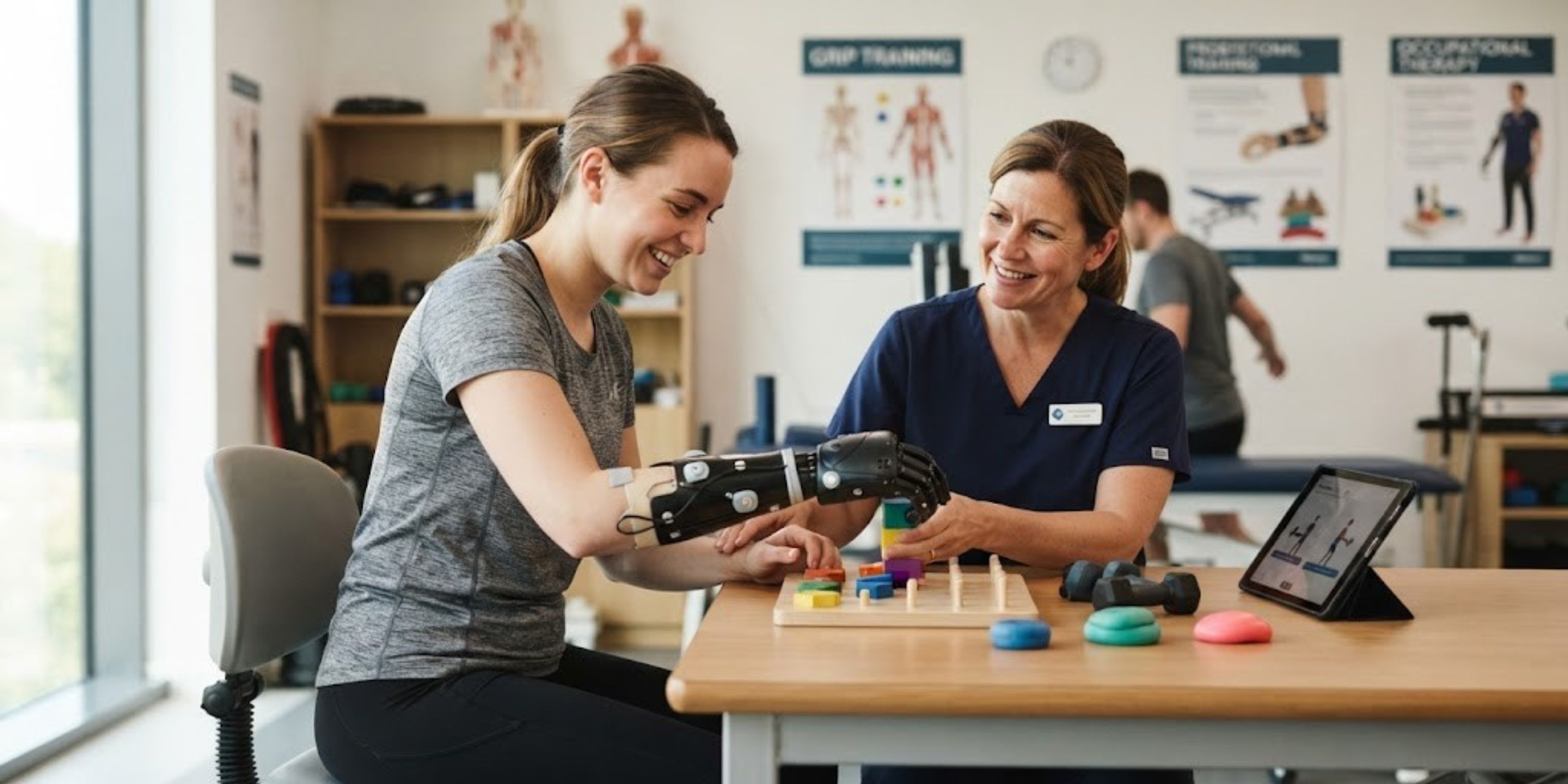
Stacking cups, blocks or other suitable objects adds another level of precision. The user needs to grip the item, position it accurately and release it at the appropriate moment.
These types of progressively challenging tasks have been used in prosthetic training to practise grasping, force modulation and functional hand use.
How Does Myoelectric Training Improve Grip Control?
Myoelectric prostheses use electrical signals generated by residual muscles to operate prosthetic functions. Users learn how specific muscle contractions affect the hand or selected grip functions.
Training may involve learning to:
- Activate the correct muscles consistently
- Produce controlled signals
- Open and close the hand smoothly
- Adjust movement according to the task
- Change between available grip patterns
- Release objects at the right moment
For systems that provide proportional control, users may also learn to produce different levels of movement rather than relying only on an on-or-off action.
The objective is not simply to contract the muscles as strongly as possible. Useful control comes from producing a signal that is consistent enough to create the movement needed for the task.
How Can Users Progress From Simple Grips To Everyday Activities?
As users progress from basic exercises to everyday activities, the type of prosthetic hand can also make a difference. Features such as grip options, control method, hand size and functional requirements should be considered when users choose the best prosthetic hand for daily activities, especially when they need to handle different objects throughout the day.
Begin With Simple Daily Tasks
Once basic object handling becomes more comfortable, users can practise tasks such as:
- Holding a bottle
- Picking up a lightweight container
- Carrying an object across a room
- Moving items between surfaces
- Picking up household objects
These activities help connect controlled movements with practical use.
Progress To More Complex Two-Handed Tasks
More advanced practice can involve tasks where the prosthesis supports the other hand. Examples may include holding a container while opening it, stabilising an object during another movement, folding clothing or managing suitable household items. Functional tasks can help users understand when to use a firmer grip and when a lighter hold is sufficient.
Why Is Repetition Important For Better Prosthetic Grip Control?
Prosthetic control is a learned skill, and repetition gives the user opportunities to build more consistent movement patterns.
Regular practice can help reinforce:
- Muscle activation
- Movement timing
- Hand positioning
- Grip-force adjustment
- Controlled release
- Coordination between reaching and grasping
However, repetition alone is not the whole answer. Practice is usually more useful when tasks are appropriately selected and gradually made more challenging. For example, repeating the same easy movement for a long time may provide less benefit than progressing from simple objects to more varied functional tasks as control improves.
How Can Users Avoid Using Too Much Grip Force?
Many users need time to learn that stronger is not always better. A useful training principle is to focus on the right amount of grip force for the task. Users can work on this by starting with stable objects and gradually practising with lighter or more compressible items. Watching how an object responds can provide visual clues about whether too much pressure is being used.
Rather than trying to squeeze an object firmly from the beginning, the user can practise closing the hand gradually and holding the object securely.
A simple progression can be:
Position the hand → Begin the grip → Check the object → Adjust force → Move → Release carefully
The sequence can become more natural as the user gains experience.
How Long Does It Take To Improve Prosthetic Grip Control?
There is no single timeline that applies to every prosthetic user. Progress can depend on factors such as:
- Type of prosthesis
- Amputation level
- Previous prosthetic experience
- Muscle control
- Control system
- Training routine
- Functional goals
- Opportunities for daily practice
Different aspects of prosthetic control can also develop at different rates. Basic hand positioning may become familiar before more precise grip-force control does. Instead of focusing only on how quickly progress happens, it can be more useful to look for practical improvements such as fewer dropped objects, smoother releases and greater consistency during familiar tasks.
How Can Prosthetists And Therapists Help Improve Grip Control?
Professional support can be important when grip problems are not improving through practice alone. A prosthetist or rehabilitation professional may assess:
- Prosthetic fit
- Socket comfort
- Electrode placement
- Control settings
- Alignment
- Available grip functions
- Muscle-signal consistency
- Functional movement patterns
They can also choose exercises that match the user’s current ability and gradually increase task difficulty.
This is particularly useful when the problem is not simply a lack of practice. A fitting issue, control setting or component adjustment may affect how easily the user can operate the hand. Professional training can also help reduce unnecessary compensatory movements and encourage more efficient use of the prosthesis during daily activities.
Take The Next Step Towards Better Prosthetic Control
Better prosthetic control begins with the right combination of technology, fit and support. PROACTIVE Technical Orthopaedics works with a focus on practical prosthetic solutions that can support comfortable movement and everyday functionality. As a prosthetics components manufacturer in India, we understand that every user’s requirements can be different.
Whether you need guidance on prosthetic components, hand functionality or a solution suited to your daily activities, our team is ready to help. Talk to our prosthetic team to discuss your requirements and take a confident step towards a prosthetic solution built around your needs. Your everyday movements deserve thoughtful support.
Frequently Asked Questions
Can Prosthetic Users Improve Grip Control With Practice?
Yes. Grip control is a learned skill, and structured practice can help users improve consistency when grasping, holding and releasing objects. Progress varies according to the individual and the type of prosthesis.
What Exercises Help Improve Prosthetic Grip Control?
Controlled hand opening and closing, picking up and releasing objects, transferring objects and stacking suitable items can help practise coordination and force management. Exercises should be adapted to the user’s prosthesis and rehabilitation needs.
How Can A Myoelectric Prosthesis Control Grip Force?
A myoelectric prosthesis detects electrical activity generated by residual muscles. Depending on the prosthesis, these signals may be used to control hand movement and different levels of movement or grip.
Why Do I Keep Using Too Much Force With My Prosthetic Hand?
A prosthetic hand does not provide the same natural sensory feedback as a biological hand. Users may therefore need to rely on visual feedback and repeated practice to learn how much force is appropriate for different objects.
When Should A Prosthetic User Get Professional Help With Grip Control?
Professional assessment can be useful when objects are frequently dropped, the hand behaves unpredictably, control remains inconsistent or the prosthesis causes fit or comfort problems. A prosthetist or rehabilitation professional can assess both the device and the user’s training approach.