

Summary: Choosing the right knee joint is crucial for above-knee amputees. This guide explains the main types of prosthetic knee joints (mechanical, polycentric, pneumatic/hydraulic, and microprocessor) and how to match them to patient needs. We cover key specs (durability, weight limit, cost) and procurement tips in India. With this information, clinics and rehab teams can select knees that improve stability and gait while optimizing budget and support.
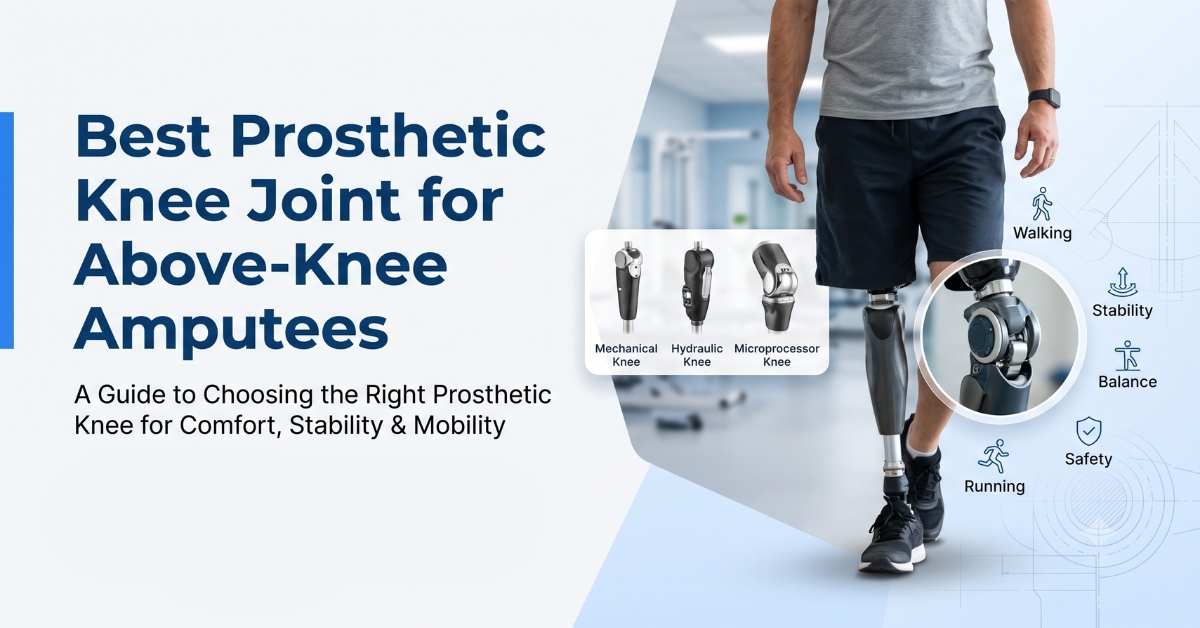
An above-knee (transfemoral) prosthetic limb relies on a knee joint to enable flexion and stability. Knee joints vary from simple hinges to smart microprocessor units. The ideal knee restores a natural gait and safety. It also enables activities like sitting, stair negotiation, and maneuvering obstacles safely. Selecting the wrong knee can lead to falls or instability. This guide helps practitioners and patients compare options and identify the best knee joints based on activity level, durability, and cost.
Types of Prosthetic Knee Joints
Single-Axis (Constant-Friction) Knees
A single-axis knee uses a simple hinge with friction or a locking brake. These joints are very durable and light. They are best for K1–K2 amputees who walk at low speeds (e.g. household ambulation). Pros: low cost and minimal maintenance. Cons: no inherent stance stability (the user must actively control the knee).
Polycentric (Multi-Axial) Mechanical Knees
Polycentric knees have multiple linkages (typically 4-bar) so the axis shifts during flexion. This provides extra stability under load and effectively shortens the prosthetic leg during swing, improving toe clearance. They suit active K2–K3 users. Pros: enhanced stance stability and a smoother gait. Cons: heavier, more parts to align and service.
Pneumatic and Hydraulic Knees
Pneumatic/hydraulic knees add air or fluid damping for adaptive swing control. An internal piston-cylinder modulates knee motion: resisting fast flexion (at higher gait speeds) and easing slow flexion. For example, PROACTIVE’s 6-bar SYMPHONY NK-6 uses hydraulic swing control and an adjustable extension-spring. These knees allow comfortable walking at varied speeds and safe descent of stairs. They suit K3 community ambulators who benefit from dynamic response without electronics.
Microprocessor-Controlled Knees
Microprocessor knees have onboard computers and sensors. They continuously adapt resistance in real time (hundreds of times per second) based on gait and terrain. MPKs can optimize stability (including stumble recovery) and allow true step-over-step stair descent. They are ideal for very active K3–K4 patients or those with high fall risk. Pros: near-natural gait and superior safety. Cons: highest cost (several lakh rupees), heavier, require battery charging and software maintenance.
Matching Knee to Patient Profile (K-Levels)
- K1–K2: Use simple mechanical knees (single-axis or basic polycentric). These provide basic stability and are very affordable.
- K3: Community ambulators who vary speed. Benefit from hydraulic or pneumatic knees, and some K3 users can access microprocessor knees if budget allows.
- K4: High-activity users (athletes, workers). Microprocessor or sports-specific knees offer maximum performance.
Also consider patient-specific factors. Longer residual limbs give more leverage but may restrict bulky knees. Weaker muscles or balance issues favor knees with automatic stability (locking mechanisms or computerized control).
Durability and Maintenance
Mechanical knees (single-axis and polycentric) excel in durability. They have few moving parts and can endure dust and rough use, needing only occasional lubrication. Pneumatic/hydraulic knees also last many years but require periodic service of seals or fluid. They are heavier (often 1–1.5 kg) but still manageable. Microprocessor knees combine mechanics and electronics; they need regular charging and professional servicing, but high-end models are built for long life. In all cases, schedule periodic check-ups to verify alignment and function.
Weight Limits and Fit
Always match the knee’s weight rating to the user. Exceeding limits risks joint failure. For example, PROACTIVE’s NK-6 knee is rated for 125 kg users. Choose a higher-rated knee for heavy or athletic patients. Polycentric knees effectively shorten at flexion, providing better foot clearance – advantageous for high-steppers. Ensure the knee’s adapter matches your socket system: most use a standard tube or pyramid connector.
Cost vs. Benefits
Knee joint costs in India generally range as follows:
- Mechanical knees: ₹5,000–30,000 ($100–400) for basic hinges and 4-bar units.
- Polycentric knees: ₹15,000–30,000 ($200–400) for higher-grade multi-bar knees.
- Hydraulic/Pneumatic knees: ₹40,000–100,000 ($500–1500) for 6-bar or air-controlled knees.
- Microprocessor knees: ₹15 lakh+ ($20k+) for premium MPKs.
Higher-end knees improve gait efficiency and reduce falls, but require more investment. Balance patient budget with needs: for most K3 amputees, a mid-range hydraulic knee often provides the best value, whereas K4 users might justify a microprocessor knee’s cost.
Procurement Tips for Clinics
- Supplier type: Prefer manufacturers (e.g. PROACTIVE Technical Orthopaedics) for direct quotes and customization. Manufacturers are likelier to have components in stock and to offer technical support.
- Certifications: Insist on ISO 13485/9001 and CE marking on medical-device components. Certified quality is critical for hospital purchases and governmental projects.
- Warranty and spares: Verify warranty terms (usually 1–2 years on knee joints) and spare-part availability (springs, dampers, electronic units). Reliable suppliers stock commonly needed parts to minimize patient downtime.
- Technical support: Ensure the supplier offers fitting guidance or training. PROACTIVE, for example, provides fitting support and documentation. Having a knowledgeable prosthetist on staff is also key.
- Bulk orders: If ordering many units, negotiate volume discounts and clarify lead times. Confirm whether import duties or shipping affect delivered price.
- Affordability: Follow WHO’s GATE principles for accessible assistive tech. Choose devices that meet medical needs while extending access. PROACTIVE balances cost and quality to serve wider patient communities.
Comparison of Knee Joint Options
| Model/Type | Best for (Profile) | Key Features | Weight Limit | Price Range (INR/USD) | Certifications | Warranty | Pros / Cons |
|---|---|---|---|---|---|---|---|
| Single-Axis (Constant Friction) | K1–K2: Household/community ambulators | Simple hinge; manual or weight-activated lock | ~100–120 kg | ₹5k–15k (~$100–200) | ISO, CE (varies) | ~1 yr | + Very durable, minimal upkeep<br>– Requires active stabilization, less natural gait |
| Polycentric 4-Bar (Passive) | K2–K3: Active community ambulators | 4-bar linkages; inherent stance stability | ~120–130 kg | ₹15k–30k (~$200–400) | ISO, CE | 1–2 yrs | + More stable, better ground clearance<br>– Heavier, more parts |
| 6-Bar Hydraulic (e.g. NK-6) | K3: Active, variable speeds | Hydraulic swing and stance control | 125 kg | ₹60k–100k (~$800–1500) | ISO, CE, export quality | 1–2 yrs | + Smooth gait, shock absorption<br>– Heaviest, requires service |
| Pneumatic Polycentric (PTO-6H23) | K2–K3: Moderate activity | Air damper swing control, extension-assist | ~110–125 kg | ₹40k–60k (~$500–800) | ISO, CE | 1–2 yrs | + Adjustable cadence, no charging<br>– Air-pressure sensitivity |
| Microprocessor (C-Leg, etc.) | K3–K4: Highly active/fall-risk | Real-time sensor-driven control | ~150 kg | ₹15L+ (~$20k+) | FDA, CE, ISO | 2–3 yrs | + Adaptive, greatly reduces falls<br>– Very expensive, needs power |
Making the Right Choice
The best knee joint matches the patient’s mobility and goals while respecting weight and budget constraints. Simpler mechanical knees suit less-active users; pneumatic/hydraulic knees help community ambulation; and microprocessor knees provide the highest adaptability. Ensure the supplier offers certified, export-quality components and strong technical support. Partnering with experienced prosthetists and reliable manufacturers ensures the knee fits properly and performs as intended. For example, PROACTIVE Technical Orthopaedics offers ISO-certified knee joints and in-house fitting support to help clinics optimize patient mobility.
Contact PROACTIVE Technical Orthopaedics for catalogs, quotes, and personalized prosthetic knee solutions.
FAQs
How do I match a knee joint to a patient’s K-level?
K1–K2 patients typically use simple mechanical knees. K3 users often move up to hydraulic or pneumatic knees, and some K3–K4 candidates can use microprocessor knees if budget permits.
What are the benefits of hydraulic knees?
Hydraulic knees provide smoother, more controlled swing and can adjust to different walking speeds. They assist with stair descent and reduce stress on the sound leg, improving comfort for active ambulation.
How do microprocessor knees reduce falls?
MPKs constantly sense gait and adjust resistance instantly. Clinical studies show MPKs can cut fall rates by up to 80% compared to mechanical knees.
What maintenance do prosthetic knees need?
Mechanical knees need minimal upkeep (basic cleaning, lubrication). Pneumatic/hydraulic knees need occasional seal checks or fluid service. MPKs need regular charging and periodic software/hardware servicing.
How much do quality prosthetic knees cost?
Basic knee joints start around ₹5,000. Polycentric knees run ₹15,000–30,000. Hydraulic/pneumatic knees are ₹40,000–100,000. Microprocessor knees cost several lakh rupees (20,000+ USD).
What should I check in a supplier’s offer?
Verify ISO/CE certifications, warranty terms (usually 1–2 years), and spare part availability. Ensure technical/fitting support is offered. Manufacturers (like PROACTIVE) often provide better service and pricing.
Can any knee fit any socket?
Most modular knees use standard tube or pyramid adapters. Confirm compatibility with your socket brand. Some knees come with their own adapters as part of the unit.
What is “stance flexion” adjustment?
It allows a slight knee bend under load to absorb shock at heel strike. This adds comfort by reducing impact and prevents knee hyperextension.
Are imported knees better than Indian-made?
Top Indian manufacturers produce ISO-certified knees at lower cost. Imported knees carry brand names but are pricier with longer delivery times. Quality depends on the specific product and company.
Are prosthetic knee joints covered by warranty?
Yes. Reputable suppliers usually offer at least a 1-year warranty on knee joints. Some offer extended warranties. Always confirm warranty coverage in writing before purchase.